


"Beyond What You See "
In Beyond What You See, Ferruccio Babarcich explores the possibility of form
existing on its own terms, inhabiting a space between painting and sculpture. His
work does not pursue representation or narrative. Rather than describing or
symbolizing the external world, each piece quietly refers to itself. This approach
reflects a sustained commitment to formal exploration that has remained central to
the artist’s practice since his earliest works.
Edges and transitional curves play a crucial role in Babarcich’s work. They are not
merely devices that separate one form from another, but quiet thresholds where
relationships emerge. The spaces and intervals within the work are not empty; they
become places where tension, balance, and coexistence unfold.
He searches intuitively for forms that resonate with him, refining surfaces, edges,
and transitions until a sense of equilibrium is reached. What ultimately emerges is
less an assertion than a presence one that feels closer — to sensation than
explanation, and closer to silence than statement. Exploration itself remains essential
to his artistic process.
The relief works in this exhibition occupy an ambiguous spatial condition. They lean
against the wall without becoming part of it, and possess volume without
aggressively claiming surrounding space. This “in-between” state is central to the
exhibition. It suggests a mode of existence that resists domination or intrusion while
sustaining the possibility of relation through distance and restraint.
At a time when much contemporary art emphasizes participation and immediate
interaction, Babarcich’s work instead invites slower observation and quiet
attentiveness. These works do not perform or demand relationship. Rather, they hold
the possibility of relation within distance, silence, and the careful awareness of form.
This exhibition can also be understood through the perspective of “the aesthetics of
relationship.” The forms neither merge nor collide; instead, they coexist within
measured distance and subtle tension. The gaps and spaces within the work are not
empty voids, but places where relation quietly resides.
What remains after viewing these works is less an image than a condition of
perception: a slowing of breath, a softened awareness, and a renewed sensitivity to
how separate forms—and perhaps separate lives—can coexist within shared space.
Ferruccio Babarcich studied Studio Art and Education at New York University, with
an emphasis on painting and photography, and later studied Interior Design at
Parsons School of Design. His work has been exhibited at Studio Montclair (2025),
Sculptors Alliance in New York (2021), SOHO Photo, and in various solo and group
exhibitions.
Look beyond what you see."
Curatorial Notes by Yung C. Kang

Visual artist Lemar Kim will present her first U.S. solo exhibition, HELLO WORLD, at ACC Gallery from May 26 through June 6, 2026. This exhibition brings together her signature character works and paintings, featuring a diverse range of artworks including paintings, digital print editions, and installation elements that showcase the breadth of her artistic expression.
Lemar Kim's work goes beyond playful character imagery to explore the emotional narrative of life. Her signature "Double L Smile" symbolizes Love, Laughter, Liveliness, and Life, serving as a visual language for the emotional highs and lows that all people encounter throughout life. Guided by the philosophy that "Only the clouds that bring rain can create rainbows," her work reflects a journey through hardship, growth, and the dreams and hope we discover after turning through many pages of life.
The exhibition title HELLO WORLD serves as both Lemar Kim's first greeting to American audiences and a message of new beginnings. Much like the familiar phrase used in programming to mark a first launch, this exhibition symbolizes the opening chapter of her journey onto the global stage.
The exhibition will feature new paintings centered around her signature character Kurumi, alongside digital print editions, object works, and wearable pieces that expand her artistic language into physical forms. Through vivid colors, pop-inspired visual language, and emotionally resonant imagery, Lemar Kim creates an experience that connects with contemporary audiences in a warm, intuitive, and uplifting way.
More than a character exhibition, HELLO WORLD explores the emotional moments each person encounters throughout life, and the hope discovered at the end of those experiences. Beneath the cheerful and approachable imagery lies a deeper message about resilience, healing, and the courage to move forward.
The opening reception will be held on May 28 from 5:00pm to 7:00pm where Lemar Kim will also present a live drawing performance, offering visitors a rare opportunity to experience her creative process in real time. Beyond viewing completed works, audiences will be invited to witness the artist's spontaneous energy and direct engagement as the act of creation unfolds live.
Guests attending the opening reception will also receive a special gift from TUMPY, a jelly brand for which Lemar Kim led the branding and character design. This collaboration highlights the artist's ability to extend her creative language beyond fine art into commercial brand storytelling, demonstrating the versatility of her visual identity across disciplines.
Lemar Kim graduated from Konkuk University with a degree in Communication Design and has worked across painting, digital art, video, performance, and character-based visual storytelling. After participating in numerous art fairs and exhibitions in Korea, she now expands her artistic journey internationally with her first solo exhibition in the United States.
Echoes Across the Hudson
Korean Contemporary Practices in the New York Region
May 05 ~ May 23,2026

Echoes Across the Hudson
Korean Contemporary Practices in the New York Region
New York, NY —
The upcoming exhibition “Echoes Across the Hudson” brings together a dynamic group of contemporary Korean artists working across the New York Tri-State region. The exhibition presents a wide spectrum of artistic practices that reflect the evolving experiences of artists navigating between cultures, cities, and identities within today’s global art landscape.
Featuring works in painting, sculpture, installation, photography, and new media, the exhibition highlights artists whose practices engage themes of migration, urban experience, memory, hybridity, and contemporary visual language. Rather than framing Korean identity as fixed or singular, the exhibition explores how cultural identity is continually reshaped through movement, translation, and lived experience.
New York has long served as a critical nexus for international artistic exchange. For many Korean artists based in the region, the city functions not only as a physical location but as an active conceptual environment where personal narratives intersect with global contemporary discourse. The works presented in Echoes Across the Hudson reveal a vibrant network of artistic voices shaped by this shared yet diverse context.
The exhibition title suggests resonance and connection across distance. Like echoes traveling across water, these artists’ works carry layered cultural memories while generating new forms of expression within the present moment. Together, they form a compelling snapshot of Korean contemporary artistic practices unfolding across the New York region today.
Participating artists
Eunchong Kim, Jinhong Kim, Jinsook Lee, Agnes Woo, Yun Jung Rhee, Minji Seo, Ahyun jeon, Stephanie Kim
Stephanie Soyoung Moon, Suena Kim, Helen Draves, Hyun Jung Kim, Hongmi Kim Hoog, Hyo Jin Jeon, Soonah Kim


JOO solo show
March 02 ~ March 28


Press Release
Ripples of Time
Joo Solo Exhibition (March 04 ~ March 28)
Ripples of Time presents a new body of work by Joo that examines the relationship between time, the ego, and the unconscious. In this exhibition, time is not understood as linear progression but as recurrence—overlapping, returning, and expanding like ripples across the surface of consciousness.
Joo approaches the self not as a fixed or singular center, but as a structure in continual negotiation. Her work resonates with the analytical psychology of Carl Jung, who understood the unconscious as a generative symbolic field rather than merely a repository of repression. In Kim’s paintings, identity emerges through tension: between what is visible and what remains submerged, between constructed reality and psychic depth.
Antique chairs frequently appear as central motifs. These meticulously rendered objects evoke civilization, rational order, and accumulated histories. Yet they are almost always unoccupied. Their emptiness suggests absence while simultaneously invoking presence—traces of those who once inhabited, or were meant to inhabit, these spaces. Through this paradox, Joo destabilizes the apparent solidity of the material world.
Surrounding these structured forms are fluid expanses created through alcohol ink and watercolor. The unpredictable dispersal of pigment visualizes the instability of dreams, memory, and the unconscious. Curtains occasionally divide the composition, marking a threshold between the tangible and the intangible. Small figures, such as rabbits, appear as symbolic guides, hinting at passage into unfamiliar psychological terrain. The juxtaposition of realistic figures and organic abstraction creates a dynamic tension between control and surrender.
Ripples of Time invites viewers to reconsider the stability of identity and the certainty of reality.Joo’s paintings do not offer resolution; instead, they hold a suspended moment—like a ripple before it dissipates. Through layered imagery and material contrasts, the exhibition proposes that the self, like time, is never singular or complete, but recursive, stratified, and perpetually in motion.
Joung, Chang Ki solo show
Dec 01 ~ 07,2025

The Ecology of Thought: Organic Paintings and the Sociology of Interpolarity
In the age of ecological crisis and fractured civilizations, the paintings of Joung Chang ki arrive as both balm and provocation, gestures that summon us back into relation with the living tissue of the world. His brush, steeped in calligraphy and tempered by silence, does not merely lay pigment on canvas. It cultivates thought as one cultivates a field, with patience, discipline, and a willingness to be transformed by the seasons of the earth.
His exhibition A New Horizon in Korean Contemporary Art unfolds not as spectacle but as ritual ecology. Here, yin–yang cosmology, and the meditative emptiness of traditional Korean landscape painting are not ornamental citations of heritage. They are organic architectures of being, reinterpreted in the language of contemporary abstraction. Joung’s canvases pulse with vibrant Korean colors yet breathe with Western expressionist intensity, harmonizing cultural codes that were once opposed. This is the reconstructive interpolarity of his practice, the recognition that life thrives not in purity but in the fertile crossing of difference.
From the sociological perspective, Joung’s work resonates with the idea of ecological civilization, a horizon in which culture, politics, and nature are no longer imagined as discrete realms but interwoven strands of the same web. His paintings are not illustrations of this philosophy. They are performances of relationality. When his calligraphy brush dances across a field of layered pigments, the movement is not private. It is a public act of world-making, an invitation to the audience to inhabit a cosmos where void and form, East and West, tradition and innovation no longer clash but converse.
Albert Tang
Um Jae Guk
solo show
11/24~11/30, 2025

Um Jae Guk’s exhibition, Ludens art, broadly draws on the theme of ludere, or “play”, as conceived of in cultural theorist Johan Huizinga’s treatise, Homo ludens: a study of the play element in culture (1938). The exhibition is something of an intermedia Gesamtkunstwerk, including Cobalt-Klein blue canvases punctuated by spilled, ribboning impasto skeins, droplet- besmirched textiles, and vari-colored ttakji toys whose thick rectangular folds are painted in motley azure, chartreuse, and speckled strokes. Creme-colored and unspooling fingerless gloves tacked on an upright panel grow threadbare as the fabric spills into a cascade below. A glowing ultramarine canvas, inspired by Yves Klein’s palette, sits, punctured by slit pocks that suggest a thrusting-piercing mechanism. Although this work in particular does not represent any perforating device, in another canvas we find such a tool impaling rust-red and flecked-white globules, beaded along the picture plane.
Each of Um Jae Guk’s works is steeped in a kind of sensorial archival history that admits of usage past, including apparently purposive tool- and garment-use rendered unusable by way of artistic predication. In turn, the objects are, as the artist themselves notes, “poetic metaphors” that home in on the notion of authorial creation vs. audience participation. In particular, the richly colored ttakji, counterposed with the static canvases, evince this dichotomy. In this manner, Guk is working in a rich tradition that includes artists like Steve Balkin, Richard Tuttle to Scott Buron, each of whom created phenomenologically attuned toy-based works during the latter half of the 20th century. In addition to such artistic precedents, Um Jae Guk’s installation- based enterprise is preceded by venerable exhibitions like Betty Parsons’ 1963-64 Toys by artists and the 1975 exhibition, Artists make toys at The Clocktower Gallery, each of which was galvanized by aspiration to collapse categorial divisions between a self-standing static work and aleatory audience participation.
Hongbin Kim
solo show
Oct 28 ~ Nov 15,2025

ACC Gallery is pleased to present Between Two Homes: Fragments, a solo exhibition by Hongbin Kim, on view from October 28 to November 15, 2025 at its Tenafly location in New Jersey. This exhibition features a series of paintings that visualize the artist’s emotional experiences and fragments of identity formed between two worlds—Korea and the United States.
The exhibition includes two major bodies of work: the MAYFLY series, which captures fleeting emotions and ephemeral moments of everyday life through vibrant colors, and the Nameless Cocoon series, which explores inner transformation and the emergence of new identity through the form of a cocoon.
Kim uses layers of color as units of memory and emotion, expressing the complex rhythm of life that arises when these fragments collide and overlap. Each fragment of color represents a piece of personal experience while simultaneously contributing to the visual order of the entire composition. Through this process, the artist transforms chaos into order, experience into reflection, and expands painting as a language of self-exploration.
The exhibition title, Between Two Homes: Fragments, extends beyond the physical concept of “home.” It symbolizes the emotional boundaries and divided sense of identity the artist has experienced while navigating between two cultural spaces. Kim visualizes the fragments of emotion discovered within these boundaries, reconstructing them into new forms of balance and identity through painting.
Jae Won Kim Solo Show
Oct 6 ~ 26, 2025

Jaewon Kim's solo exhibition will be held at ACC Gallery from October 6-25, 2025. This 13th solo show is her U.S. debut, continuing her long-standing exploration of "dreams."
She studied both painting and printmaking at Hongik University, developing her own pictorial vocabulary by moving between the two mediums. Her works feature intricate printmaking-inspired lines, soft pastel tones, and warm, illustration-like compositions. This distinctive visual language invites viewers to uncover the layered meanings hidden within her art.
Through series such as Stories of Dreamers and Village in Dreams, Kim has consistently pursued the theme of dreams. At first glance, her works evoke a childlike, fairy-tale lyricism, yet they move beyond nostalgia for childhood worlds. With gentle colors and familiar motifs, she disarms the viewer, revealing metaphors of simple joys, hope, and everyday beauty.
A notable element of this exhibition is the presence of "resort-like landscapes." Tropical trees, clouds, and flowers combine to form dreamlike utopias—unfamiliar yet comforting. Rather than serving as mere decoration, these landscapes evoke a sense of ease and leisure.
The recurring motif of the "house" also plays a central role in her dream narratives. Inspired by her childhood pet's doghouse, this motif intertwines with trees, cakes, strawberries, and other elements to create layered meanings. These images are not simply surreal fantasies but intersections of reality and imagination, symbolizing a shared longing for refuge in uncertain times. Warmly and intimately rendered, the "house" offers viewers a space of comfort and rest.
Ultimately, the exhibition reflects a modern desire to step away from daily life and dwell within dreams. From personal memories to contemporary realities and into dreamscapes of rest, Kim presents a holistic view of her artistic journey. Kim notes: "I hope this exhibition offers each person a chance to awaken the dreams within their hearts and to write their own stories."
Jaewon Kim invites audiences to rediscover the value of dreams, rest, and everyday life amid contemporary realities.
INJOO WHANG Solo Show

FOR IMMEDIATE RELEASE
In Repetition
A Solo Exhibition by Injoo Whang
ACC gallery
September 13, 2025 - October 4, 2025
Opening Reception: September 13, 2025, Saturday, 4pm
(Tenafly, NJ) — ACC Gallery is proud to present In Repetition, a solo exhibition by mixed media artist Injoo Whang. The show features Whang’s latest works, including abstract works on paper and collages created with sumi ink and water-based mediums.
Inspired by architectural elements, Whang recomposes forms into intricate abstract compositions. Each piece begins with a single mark or paper cut-out, which she repetitively accumulates to form a larger whole. This approach is rooted in traditional Korean painting and calligraphy, where “gi (기)”—the infusion of energy—is cultivated through sustained repetition and spiritual practice. Similar to the traditional technique of layering thin, translucent pigments dozens of times to achieve depth and illumination, Whang builds meaning and presence through careful accumulation.
Through this meditative process, Whang explores the interplay between the individual and the collective, positive and negative space, and simplicity and complexity. The energy generated through repetition creates immersive abstract landscapes, inviting viewers into contemplative spaces shaped by collective existence.
Artist’s Biography
Injoo Whang (b. 1977, Seoul, Korea) is a mixed-media artist whose work draws inspiration from architectural elements. Through repeated marks and layered gestures, she reconfigures them into geometric abstract works on paper and collages using sumi ink and water-based mediums.
She earned a BFA in Korean Traditional Painting from Hong-Ik University in Seoul before moving to the United States in 2002. In 2004, she received her MFA in Fine Art from Parsons School of Design in New York.
Whang’s work has been exhibited at venues including the Queens Museum of Art (NY), LA Artcore (CA), McColl Center for Visual Art (NC), Lee Gallery at Clemson University (SC), and the Total Museum in Seoul. She has been awarded fellowships at the Vermont Studio Center (VT), the Constance Saltonstall Foundation for the Arts (NY), the Anderson Center for Interdisciplinary Studies (MN), the Kimmel Harding Nelson Center for the Arts (NE), and PS122 (NY).
She currently works out of her studio at Camden FireWorks in Camden, NJ, and lives in Cherry Hill, NJ.
황인주 초대 개인전: 반복의 반복 - In Repetition
9월 13일부터 10월 4일까지 황인주 작가의 초대전, “반복의 반복- In Repetition”을 개최한다. 이번 전시에서는 황인주의 최신 작품, 수묵과 수성 재료를 사용한 추상 회화와 콜라주를 선보인다.
황인주 작가는 건축적 공간에서 영감을 받아 그 안의 요소들을 재구성하여 작품으로 풀어낸다. 모든 작품은 하나의 선이나 종이 조각에서 시작되며, 반복적으로 축적되어 더 큰 전체를 형성한다. 이러한 과정은 한국 전통 회화와 서예에 뿌리를 두고 있으며, 기(氣) — 에너지를 불어넣는 행위 — 는 반복과 정신적 수련을 통해 길러진다. 얇은 안료를 수십 겹 쌓아 깊이와 빛을 얻는 전통 채색 기법처럼, 작가의 작업 또한 축적을 통해 의미를 쌓아간다.
이러한 명상적 과정을 통해 작가는 개인과 집단, 채움과 여백, 단순함과 복잡함 사이의 관계를 탐구한다. 반복의 행위 속에서 응축된 에너지는 추상적 풍경으로 펼쳐지고, 그 안에서 관객은 깊은 사유의 공간에 머무르게 된다.
황인주 (1977년 서울 출생) 는 건축적 요소와 한국 전통 회화의 철학에서 영감을 받아, 반복적인 선과 제스처, 레이어링 과정을 통해 수묵과 수성 재료를 활용한 종이 작업과 콜라주를 기하학적이고 추상적인 형태로 재구성한다.
홍익대학교에서 한국화 전공으로 학사 학위를 받은 후, 2002년 미국으로 건너가 2004년 뉴욕 파슨스 스쿨 오브 디자인에서 순수미술 석사 학위를 취득하였다.
황인주의 작품은 국내외에서 다수의 개인전과 그룹전에서 전시되었다. 뉴욕 퀸즈 미술관, LA Artcore, 노스캐롤라이나 McColl Center for Visual Art, 사우스캐롤라이나 클렘슨 대학교 Lee Gallery, 서울 토탈미술관 등에서 단체전에 참여했으며, 버몬트 스튜디오 센터(VT), Constance Saltonstall 재단(NY), 앤더슨 센터(MN), Kimmel Harding Nelson 센터(NE), PS122(NY) 등에서 펠로우십과 레지던시를 수상하였다.
현재 뉴저지 Camden FireWorks에서 스튜디오를 두고 활동하며, Cherry Hill에 거주하고 있다.
Jinchul Kim Solo Show
"Cinema 25 : The color of Liminality"
8/09 ~ 8/30,2025
opening reception 8/09 (Sat) 5~8pm

Kayleigh-Quantum Entanglement, 2025, Oil on canvas, 22 x 39 in.
Jinchul Kim’s invitational solo exhibition,
The opening reception and Gallery Talk are scheduled for Saturday, August 9, from 5 to 8 PM. This exhibition presents Kim’s latest works, which draw inspiration from cinematographic composition and image manipulation, blending these visual approaches through the language of painting to create connections across different artistic elements. This exhibition provides an opportunity to engage with Kim’s innovative exploration of liminality and the interplay between film and painting.
Artist Statement
I am deeply interested in exploring and redefining the boundaries of various concepts that have often been rigidly categorized under the term "aesthetics." This pursuit leads me to innovatively reconstruct the preconceived definitions established by the art world in the past, integrating diverse perspectives to create a more inclusive language. Throughout this process, I develop unique personal semiotics and investigate new possibilities for painterly expression based on it. My semiotic explorations are strongly reflected in my work, which is combined with meticulous synchronic strategies.
Whether in abstract or expressive environments, I favor a formal approach that builds painting on a solid structure. This method encourages viewers to actively engage with the visual "game," revealing and concealing meaning through newly presented compositions. The tension and harmony created by the structural firmness of the painting, along with the aesthetic beauty of its surface, also play significant roles in my work.
The philosophical ideas rooted in Husserl's phenomenology, Deleuze's assemblage theory, quantum mechanics, and the intersection of modern physics and philosophy form a core foundation for my artistic thought. Through this theoretical reflection, I continuously seek to reinterpret the essence of painting and to understand reality not as a fixed essence or identity, but as something defined by difference, relation, and constant change, explored through aesthetic experimentation.
JINCHUL KIM
Professor of Art | Director, Senior Exhibition
Head, Painting & Drawing
Chair, Portfolio & Scholarship Committee
Art Department
Fulton School of Liberal Arts
Salisbury University
1101 Camden Ave, Salisbury, MD 21801
Office #: FH 219, 410-543-6274
Michelle Chu
solo show
May 12 ~ JUne 07, 2025

Artist Note - Michelle Chu My artwork simply epitomizes my daily routine. I often become extremely delighted when my viewers are inspired through my work which shows day-to-day chore that my viewers see through my intention involuntarily, and to put a little smile on them who feel and share the common ground of my expression. I consistently struggle with myself. I put in a great effort to my artwork in order to extract my strongest and honest gut feelings because I believe that acknowledging and admitting my weakness would be the most effective means to minimize the sadness and my agony. Although I am unable to predict how my work will progress, I often ask myself one important question: Have I really been working on my art solely for seeking a higher ground? The primary objective in my artwork is to cherish and value the initial motivation that initiated a spark during my incipient era. I will continue to strive to display courageous attitude, honesty, and constructive thinking to myself and my viewers through my artistry.

Jae Hi Ahn
solo show
April 14 ~ May 10, 2025
Reception 6~8 pm April,19 (SAT)
Jae Hi Ahn' work centers on community well-being including the relationship
between human and nature, and the connection between different cultures and
different races in the community. She examines the relationship between her Korean
Cultural background and the community's natural & multicultural surroundings by
re-imagining & interconnecting cultural objects, memories, daily life, & Nature in
order to bring the awareness of social inequity, sustainability, and Hope.
Home series explores Community Well-Being through her Korean Cultural background
and also her community's Natural & Multicultural surroundings. Home incorporates
porcelain ceramic sculptures and photography. Home was initiated with the story,
"The Condolence Letter", that Ahn's 16th century ancestor wrote to his late wife who
passed due to complications with postpartum. During Covid-19 pandemic, racial and
ethnic minority groups reported experiences of Covid-related discrimination in the
community. Ahn wants to dedicate her project to people around community who
have been suffering through the loss of loved ones, Anti-Asian racism, gender
inequalities of minority women, and more.
Home Series, Women & Nature, includes the images of Hwagwan: Crown for
Female's wedding, incense burner, Daenggi: A traditional ribbon for a girl's braided
hair, cups, rice bowl, & flowers from her community/memory. These images are
interconnected to each other through women's breast milk ducts, umbilical cord, &
braided hair. The umbilical cord serves as a vital lifeline, providing oxygen, nutrients,
and removing waste products from the fetus. Breast milk ducts function to transport
breast milk acting as network of tubes that carry the milk to feed the baby.
Women's braided hair symbolizes cultural heritage, identity, community, and
connection to ancestral roots. Korean women's braided hair changes after they get
married.
Ahn hopes to connect human and nature, and different cultures and different races
together across the community in NYC.
Jae Hi Ahn is a Korean born, New York based artist. Her art practice explores
multidisciplinary arts including installation, sculpture, ceramic, photography, and
watercolor painting. Ahn examines the relationship between her Korean Cultural
background and the community's Natural & Multicultural surroundings by
re-imagining & interconnecting Cultural objects, memories, daily life, & Nature in
order to bring the awareness of social inequity, sustainability, and Hope.
Ahn’s work has been presented widely in New York at venues that include Sunroom
Project Space at Wave Hill, Bronx; Chashama, NYC; White Columns Online, NYC;
Steinhardt Conservatory Gallery at Brooklyn Botanic Garden; Broadway Windows at
New York University; The Field Sculpture Park at Art Omi, Ghent; Elizabeth
Foundation for the Arts, NYC; LMCC’s Arts Center at Governors Island; Stone Quarry
Hill Art Park, Cazenovia, NY, and Nathan Cummings Foundation, NYC.
She has been awarded grants from Queens Arts Fund (NYFA/DCLA), The Puffin
Foundation, Brooklyn Arts Council Community Arts Regrant (NYCDCA), Urban Artist
Initiative Fellowship, NYC, and has participated in various residencies at LMCC Swing
Space, NYC; Ragdale Foundation Residency, Lake Forest, IL; I-Park, East Haddam,
CT; VCCA, Amherst, VA; Hambidge Center, Rabun Gap, GA; and Sculpture Space
Residency, Utica, NY.
Her work is currently included for the Curated Artist Registry at White Columns and
she's a participant of NYFA's 2025 Immigrant Artist Mentoring Program, NYC. Her
work has been featured in The New York Times, The L Magazine, The Brooklyn
Paper, The Brooklyn Rail, The Artist of the Month at Bric Rotunda Gallery and
Untapped New York.

Heejoo Kim solo show

Temporal, spatial, cultural, and social restrictions confine the eidetic vision that emerges from daily experiences. Everyday encounters spark profound questions and vivid imaginings, yet they often collide with the rigidity and conventions of the physical and social world. Heejoo Kim’s practice stems from a deep desire to transcend these limitations through virtual media, particularly from the perspective of underrepresented communities. The simulated domain serves as a means of liberating both conceptual and physical environments, expanding the boundaries of what is possible. For Kim, the process of creating digital mixed media is imbued with nostalgia for traditional art forms such as painting and sculpture—yet, paradoxically, it is fully realized within the intricate digital realm.
Kim’s current research extends her exploration of marginalized communities, driven by her commitment to anti-discrimination and tolerance. Her work reflects a hopeful vision for humanity, continuously investigating adaptable emerging technologies to address contemporary social and cultural issues. Through these media, she examines hidden social narratives, challenging viewers to reconsider their preconceptions—not only about these issues but also about the evolving role of technology in shaping discourse.
An internationally recognized, award-winning new media artist and experimental mixed-media filmmaker, Kim focuses on critical social issues, including microaggressions, feminism, elder abuse, racism, and psychological themes. Her interdisciplinary approach merges storytelling with emerging technologies, pushing the boundaries of visual narratives in contemporary media.
Her films and installations have been showcased at prestigious festivals, conferences, and galleries worldwide, earning numerous accolades, including Best Experimental Film and Best of Show at highly competitive international film festivals and academic conferences. Beyond her artistic practice, she has played a crucial role in shaping the landscape of new media art and film. She has served as a director, curator, coordinator, and adjudicator for leading international animation and new media art festivals, fostering global conversations on digital media’s evolving role.
An accomplished educator, Kim has held faculty positions at institutions, including the School of the Art Institute of Chicago (Art and Technology Studies), Columbia College Chicago (Interactive Arts and Media), Bowling Green State University (Digital Arts), and the University of Montana (Media Arts). She currently teaches at the University of Connecticut, where she continues to inspire the next generation of media artists.
Her dedication to experimental storytelling, social advocacy, and technological innovation is instrumental in shaping the dynamic and ever-evolving realm of new media art. By challenging artistic conventions and integrating emerging technologies, she fosters critical discourse, questions societal norms, and redefines the possibilities of emerging media.

Circus Animals
Participating Artists: Shelly Lapearl, Minjin Lee, Josh Pascual, Kun Kyung Sok Dates: Mar 3rd - Mar 15th
The circus is, at its core, a space of joy and exhilaration. Clowns in dazzling costumes, animals performing astonishing tricks, and the glow of brilliant lights transport audiences into a world of wonder. Yet behind this spectacle lies a hidden reality—one that often goes unseen. Human performers push their bodies to the limits, transforming themselves into technical marvels that inspire awe while simultaneously being consumed as commodities in a capitalist society. The reality for animals is even more brutal. The group exhibition "Animal Circus," featuring four artists, delves into this dual nature of the circus—both its spectacle and its unseen struggles.
Holiday special show
my story in the past, magical and imaginary beings and lands
Dec,23 2024 ~ January 31, 2025

The idea of my recent works are a reconstruction of objects I abtained and many places i traveled from my past. Besides, something happened in my imagination. Each object, places, imaginationss represent a each separate memory, but when those are assembled together, it becomes a new meaning in my personal story.
by Hobong Kim


ACC 갤러리 홍예진 소설가 초대전 Mystical Nostalgia
뉴저지 테너플라이에 위치한 ACC 갤러리에서 오는 11월 11일부터 11월 25일까지 소설가 홍예진 초대전 Mystical Nostalgia를 연다. 코네티컷의 해안 마을에 거주하는 홍예진은 뉴잉글랜드 특유의 자연, 건축물, 사람들 사이에서 체험한 삶의 단면과 성찰을 담은 소설과 산문을 쓴다. 날카롭고 우아한 문체를 구사한다고 알려진 그녀는 집필 기간 틈틈이 붓을 들어 자신의 책에 등장하는 이야기와 풍광을 화폭에 담아내고 있다. 소설가인 동시에 겸업 화가로서의 신호탄이 될 이번 전시를 통해 그간의 결과물을 대중에 선보인다. 작가는 경희대 산업디자인과를 졸업한 후 프랑스 파리 École supérieure des arts et techniques에서 무대 미술을 전공했으며 2001년부터 미국으로 이주해 살고 있다. 외교부 주관 재외동포문학상 공모에서 단편 <초대받은 사람들>로 소설 부문 대상을 받아 작품 발표를 시작했다. 이후 장편소설 <소나무 극장>, 산문집 <매우 탁월한 취향>과 <나의 외로운 지구인들에게>를 집필해 출간했다.
ACC Gallery presents “Mystical Nostalgia”, an invitational exhibition by novelist Yeajin Hong
The ACC Gallery in Tenafly, New Jersey, will host Yeajin Hong's Invitational Exhibition “Mystical Nostalgia” from November 11 to November 25. Hong, who lives in a coastal town in Connecticut, writes novels and prose that capture the experiences she had living among the nature, architecture, and people unique to New England. Known for her sharp and elegant writing style, she occasionally picks up her brush to paint the stories and landscapes from her books. This exhibition, which will be a signal flare for her as both a novelist and an artist, will showcase her work to the public. After graduating from the Department of Industrial Design of Kyung Hee University, Hong majored in stage art at the École supérieure des arts et techniques in Paris, France, and has lived in the United States since 2001. She began publishing her works after winning the grand prize in the novel category for her short story <The Invited> at the Overseas Koreans Literature Award hosted by the Ministry of Foreign Affairs. She then wrote and published the novel <Pine Tree Theater> and the prose collections <An Excellent Taste> and <To My Lonely Earthlings>.
Minkyung Lee solo show
Oct 26 ~ Nov 09,2024

Floating –– Nature
Observing and reinterpreting shapes and lines from nature, exploring fluid self-consciousness within them
My Floating — Nature works in this exhibition is rooted from her video and installation works “Swaying in the Power” series from a few years ago. In that series, She tried to express the essence of an object and its relationship with the environment that affects it through leaves swaying in the wind. Her interest in the interaction between each object and the surrounding environment is ultimately about finding the essence of the object.
She approached it more pictorially in these paintings. Fundamentally, the characteristics of something that we see - visually appealing objects such as flower petals or tree branches in my work - create different forms even with the same shape and show different feelings even with the same color. The objects expressed through the composition of leaves that sway subtly and the shape of tree branches that extend to an unknown location, react to the environment and also make gestures that make their own voices within itself.
This object's voice, that is, the object's identity, was explored in order to express the gestures it presents on the canvas through differences in shape, line, color, and light. She may have wanted to talk about the object's essence, its existential self through the potential changing form of the object, the abstract mass that can be inferred from that form, the movement of the line, and the subtle changes that are similar yet different.
Also, this movement is reminiscent of the stream of unconscious thoughts that are constantly changing and unsettled, as if floating. Through the experience of this mutual relationship, the object changes, and dialectically, it is not the object that She initially thought of, and she is not the person that she initially expected.
She is exploring the fluid, ultimate and floating self-consciousness in the essential self of the object in nature and in its environment.
Press Release
Oct 26, 2024
Acc gallery presents an invitational exhibition Min K. Lee solo show
under the title Exhibition Title: “ Floating”
Oct 26 ~ Nov 09, 2024
Reception Oct 26 6~9pm, 2024
17-19 Washington St. 2nd fl (CVS Building), Tenafly NJ 07670 Tel 201 390 6275
Floating –– Nature
자연에서 오는 형태와 선을 관찰 재해석, 그 안에서의 유동적 자의식 탐구
이민경은 서울대학교 미술대학 서양화과 졸업, 동 대학원을 졸업, 뉴욕 School of Visual Arts 에서 Computer Art MFA 졸업하고 6번의 개인전과 다수의 기획전시를 했다. 대한민국 미술 대전과 동아 미술제, Koch 비엔날레등 다수 국제전에서 수상을 했다. 오랜기간 판화 작업과 회화, 비디오 설치를 하였고 현재 디지털과 회화 작업에 매진하고 있다.
이민경의 이번 Floating — Nature ( 떠 있는 — 자연) 전시는 몇 해전 그녀의 비디오 작업 Swaying in the Power 시리즈에서 출발한다. 그녀는 그 작업에서 바람에 흔들리는 나뭇잎을 통해 사물의 개체의 본질과 그것에 대한 영향을 미치는 환경과의 관계를 표현하고자 하였다. 주위의 환경이란 조건과 각각의 개체, 대상과의 상호 작용에 대한 관심은 궁극적으로 그 대상의 본질을 찾고자 하는 것이다.
그는 이번 작업에서 그것을 좀 더 회화적으로 접근하였다. 근본적으로 우리가 보는 대상의 특성 - 그의 작품에서의 꽃잎이나 나뭇가지라는 시각적으로 매력적인 대상은 같은 모양에서도 다른 형태를 만들고 같은 색이라도 다른 느낌을 보여준다. 미묘하게 흔들리는 잎들의 구성과 어디인지 알 수 없이 뻗은 나뭇가지의 형태 등으로 표현된 대상은 환경에 반응하고 또한 그 안에서 자기의 목소리를 내는 몸짓을 한다. 이 대상의 고유한 목소리, 즉 그 대상의 정체성에 대한 탐구로 그것이 표현하는 몸짓을 화면에 형태, 선, 색과 빛의 변화로 표현하고자 하였다.
그는 대상의 잠재적인 변화하는 형태, 그 형태에서 유추할 수 있는 추상적인 덩어리, 선의 움직임, 미묘하게 비슷하면서도 다른 변화를 통해 그 대상의 본질, 실존적인 자아를 이야기하고 싶었는지 모른다. 또한 이 움직임은 끊임없이 변화하고 정착하지 않는 마치 떠 도는 무의식적 사고의 흐름을 연상하고 있다. 이러한 상호 관계의 경험으로 대상은 변화하며 변증법적으로 그것은 자신이 처음 생각했던 그 대상이 아니고 그 자신 또한 처음 기대했던 그가 아니다.
그는 자연 속에서 환경 속에서 개체의 본질적인 자아의 유동적, 궁극적으로 떠다니는 자의식을 탐구하고자 하였다.
Bong Jung Kim solo show
Sep 18 ~ Oct 12,2024
Mix-Med2024-%243000.jpg)
"The process of selecting discarded items and transforming them into new forms of art motivates me greatly. Discarded items often symbolize the marginalized sectors and individuals within society. The process of these items being reborn within new artworks provides them with a fresh opportunity for existence. Through turning discarded items into works of art, I aim to provoke individuals, including those who are marginalized, into contemplating their own worth. This endeavor will lead us to realize the vast potential that we often overlook in those we inadvertently exclude. I believe that my work also emphasizes the creativity and adaptability of humanity by collecting and recycling discarded items to create new pieces. This process serves as a symbol of our collective eort to make the world we live in more beautiful. Lastly, my artwork conveys a message of hope and regeneration to people. Even discarded items hold new possibilities, and we must remember that through them, we can create new beginnings and futures. This serves as a reminder of the innite hope we possess as we strive to build a more equitable and sustainable society.
" 작가의 작품론 버려진 물건들을 선택하여, 그것들을 새로운 형태로 변화시켜 예술 작품을 만드는 과정은 나에게 큰 영감을 줍니다. 버려진 물건들이 상징하는 것은 보통 사회의 소외된 층이나 소수자들의 삶을 뜻합니다. 그것들이 새로운 작품 속에서 다시 태어나는 과정은 그들에게 새로운 존재의 기회를 제공합니다. 나는 버려진 물건들을 예술 작품으로 변화시킴으로써 소외된 사람들에게도 자신들의 가치에 대해 생각해보도록 유도하고자 합니다. 이러한 작업을 통해 우리가 무심코 소외시키는 사람들에게 얼마나 많은 잠재력이 있는지에 대해 깨닫게 될 것입니다. 나의 작업은 또한 버려진 물건들을 수집하고 재활용하여 새로운 작품을 만드는 과정이 인간의 창의력과 변화력을 강조한다고 생각합니다. 이러한 작업은 우리가 살아가는 세계를 더욱 아름답게 만들기 위한 우리의 노력을 상징합니다. 마지막으로, 나의 작품은 사람들에게 희망과 재생의 메시지를 전달합니다. 버려진 것들도 새로운 가능성을 품고 있으며, 우리는 이를 통해 새로운 시작과 미래를 창조할 수 있다는 것을 기억해야 합니다. 이는 우리가 지속 가능한 사회를 구축하기 위해 노력할 때 무한한 희망을 가져다 줍니다.
Jinsoon Oh solo show July 25 ~ Aug 07,2024 Reception July 25(Thurs) 6 ~8 pmJinsoon Oh, an artist based in Salisbury, Maryland, is hosting her twelfth solo exhibition at ACC Gallery in Tenafly, New Jersey. The exhibition, a culmination of her artistic journey, will run from July 24th to August 7th, 2024. Inspired by Oh's unique vision and imagination, her works skillfully tell profound stories that resonate with audiences. Her recent works explore the relationships between objects, humans, and temporality, providing compelling insights into reflective aspects of life. In the exhibition “The Space in Between,” the artist employs a unique approach, using vertical lines of various colors to deconstruct the shape and create simple yet intense expressions. Oh's bold approach captures time and space, memory and space, surrealism and space, conveying an intimate and intuitive narrative that leaves a deep impression and offers a philosophical visual perception. Additionally, the recently launched "Embrace" series aims to symbolize regaining the inner human warmth that has been lost in modern society. Jinsoon Oh is a graduate of Sejong University in South Korea and moved to the States in 2016. She is an active member of the Korean-American Artists Association in Washington, D.C. She is passionately participating in the local art scene through solo and group exhibitions in Maryland and the Greater Washington DC area, including Salisbury University, the Center for the Arts in Ocean City, Rehoboth Beach Art League, and Salisbury Art Space and has received numerous awards and recognitions.


About artist, Kim Sundoo

Bio
Yeon Jin Kim is a visual artist and filmmaker, born in South Korea and based in New York City.
Kim's most recent solo exhibitions were held at Pilseung-sa, Seoul, South Korea, the Society for Domestic Museology in New York and Albright College in Reading, PA.
Her NYSCA supported public Jogakbo project is currently installed in Inwood Hill Park in New York City.
Her films have recently been screened at the Philadelphia Asian Film Festival, New Filmmakers New York, Blow-Up Arthouse Film Fest Chicago and the Glimmerglass Film Festival in Cooperstown, NY.
Her work was featured in the book "50 Contemporary Women Artists", edited by Heather Zises and John Gosslee in 2018.
She has done numerous residencies, including Outpost Artist Resources, the Teton Art Lab, the Winter Workspace Program at Wave Hill, the Kimmel Harding Nelson Center for the Arts, the Fountainhead Residency, I-Park, the Abrons Arts Center, the Islip Museum, Sculpture Space, the Saltonstall Foundation and Yaddo.
She teaches at Binghamton University, SUNY.
ACC Gallery presents solo exhibition by Yeon Jin Kim under the title, “This, That and the Other”
As a child, Yeon Jin Kim was introduced to Jogakbo by her aunt, who owned a Hanbok (Korean traditional garment) shop. Her aunt was particularly talented at needle crafts and her Jogakbo were lovely and visually sophisticated. Examples were gifted to family members, with Kim’s mother passing one down to her, which has become an important influence.
Jogakbo developed as a way for lower-class people to wrap gifts for weddings and other celebratory events in the 17th to 19th centuries. Scrap pieces of fabric were stitched together, much like quilts, to create attractive wrappings.
Kim was inspired to update this historic Korean art form by expanding the size and replacing the traditional silk or ramie with commercial plastic bags, and even drug baggies found on the streets in her neighborhood. Recently she received a New York State Council on the Arts Grant to design and fabricate Jogakbo, using weather-proof materials, to create banners with her fellow artist Noelle Salaun, installed by the City in Inwood Hill Park in Manhattan.
Kim hopes to inspire an appreciation of Jogakbo and other Korean needlecrafts, which she feels have been undervalued in relation to Western art forms.
Kim is also deeply invested in an ongoing investigation of paper collage, utilizing various scrap papers she has found and collected for over a decade. Initially inspired by Korean Jogakbo, other influences range from the Gee’s Bend Quilters to Hannah Hoch and a wide range of other modern and contemporary collagists. Working intuitively, she improvises patterns, structures and hybrids enticing the viewer to engage, imagine and interpret.

INHO CHO solo exhibition
Feb,15 ~ 29,2024
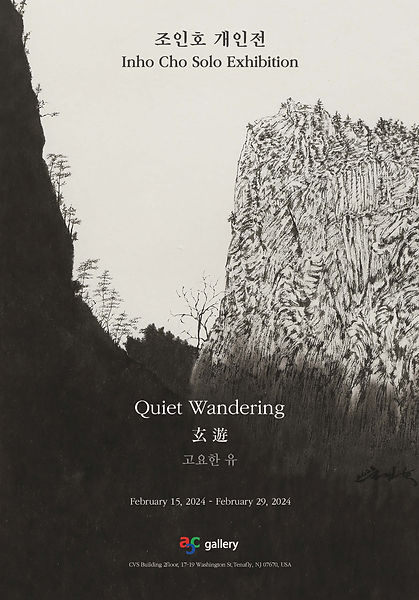

ACC Gallery presents solo exhibition by Inho Cho under the title, Quiet Wandering: A Korean Travelogue through Ink-and Wash
Curated by Sunglim Kim (Art Historian / Dartmouth College)
In “Quiet Wandering,” his first solo exhibition in the United States, Cho Inho presents diverse scenes of South Korea’s Seoraksan (Mt. Seorak) and Eastern Sea. Seoraksan is located in the middle of the Baekdudaegan, the so-called “spine of Korea,” a series of mountain ranges extending from Baekdusan (Mt. Baekdu, in far northeastern North Korea and the highest mountain in the country), through Geumgangsan (Mt. Geumgang or Diamond Mountain, also in North Korea), Seoraksan (the DMZ is between Geumgangsan and Seoraksan), Taebaeksan (Mt. Taebaek, in eastern South Korea), and Sobaeksan (Mt. Sobaek), all the way to Jirisan (Mt. Jiri, in southwestern South Korea). Seoraksan is the third highest mountain in South Korea (after Hallasan on Jeju Island and Jirisan). Cho chose to concentrate on Seoraksan, as it is one of South Korea’s most representative, favorite, and frequently visited mountains. Cho travels there at least once or twice a year, alone or with his family.
Beginning with his first Korean solo exhibition in 2007, whenever he had issues to ponder, Cho sought his answers from nature, especially while wandering, excursing, or climbing mountains. As he began each excursion, his mind might be overwhelmed by complex problems and questions, but all those entangled troubles would disappear as he achieved unity of ego with nature:
“Tip-tap, tip-tap, the crunching sound of footsteps . . .
then suddenly, my worries disappear. I hear nothing but my own
heartbeats.
Striking scenes of nature appear before my eyes.
Gathering all segments of enlightenment and perception,
and of moments of unity with nature, I render them on canvas.
The world of only black and white with no desire and greed,
The world free from deception,
I portray in ink and wash.
All the beings I meet in nature, I paint on canvas.”
Written by Cho Inho
Cho believes the work of artists must express themselves. For him, sansuhwa (山水畵), literally meaning paintings of mountains and water, and which can be translated as “traditional landscape,” is different from Western landscape painting and is what represents him and his art world.
In eighteenth century Korea, a new painting genre, called “Jingyeong sansuhwa (眞景山水畵),” appeared, led by renowned artist Jeong Seon (1676–1759). It was practiced by many painters, who traveled to the actual sites, sketched, and painted true nature, rather than simply copy old masters’ landscapes or paint “conceptual” scenes. At that time, the most popular and “must go” place was Geumgangsan, as it was considered the most beautiful and sacred site for Buddhism. After traveling from Seoul (then called Hanyang), the artists would visit inner Geumgang, outer Geumgang, and Sea Geumgang, then proceed to the Eastern Sea, or vice versa.
While Geumgangsan is not now accessible to South Koreans, as it is in North Korea beyond the DMZ, Cho was able to go to Seoraksan, following the route of the old masters. This exhibition shows how he traveled from the Eastern Sea (see “Pine Forest at Gyeongpodae,” “Hajodae,” “Uisangdae,” “Beach Near Seonang Rock,” “Jukdo,” “Geomeundo,” “Seonang Rock,” and “Songjiho Beach” in this exhibition) to Seoraksan, more specifically from Osaek to Daecheongbong (the highest peak of Mt. Seorak; see “Gwongeum Castle” and “Daecheongbong”), and down from there to view various other sites (see “Cheondang Waterfall,” “Hyeongjebong,” “Strange Rocks at Yang Waterfall,” “Mangyeongdae,” and “Oryeon Waterfall”). This exhibition is organized in a way to follow Cho’s own trip.
His sansuhwa is done only in ink and wash. Traditional landscape done that way, without any color, may not sound very attractive or visually compelling, yet Cho’s sansuhwa is intriguing, captivating, and in some ways very contemporary. His ink-and-wash landscape leaves behind, or goes beyond, the “colorful and attractive” secular life and desires. It becomes a trip through which the seekers meet their true selves. Some critics say Cho Inho’s sansuhwa is “following old but creating new (法古創新).” But is it at all possible to follow old while creating new at the same time?
Cho’s innovative method is to facilitate flowing “moving points of view” or “multi-perspectives” (as opposed to a “single point perspective”) to express his experiences of panoramic views as he continues moving around the particular site. His sansuhwa is not the depiction of the actual scene, but the reconstruction and collection of his particular enlightening “aha” moments and memories during his journey. Thus, in order to show some of the panoramic views experienced on his walks, his composition on canvas becomes bent and warped as seen in “Songjiho Beach” and “Gwongeum Castle.”
This exhibition also shows Cho’s use of bold, daring dark black for the nearest site. It is his first attempt to introduce the “beauty of negative space” or “yeobaek ui mi” in sansuhwa and traditional Korean art. As an art critic who has closely followed his progress of sansuhwa, I consider this daring black area is a very significant development. This shows his confident, creative way of portraying the “beauty of negative space.” Again, he is making another leap in his sumuk (水墨; ink-and-wash) sansuhwa.
For more than sixteen years, Cho has persisted in his pursuit of ink-and-wash traditional landscape. His approach may seem somewhat stubborn, but his interpretative modernization has been well-recognized and he received the prestigious “2023 National Academy of Arts of the Republic of Korea Award.” “Quiet Wandering” clearly shows what he went through and what he accomplished in those years. Here, Cho invites viewers to explore the exciting journey to the Eastern Sea and Seoraksan through his painting, allowing them to experience this sojourn, to leave their secular burdens behind, and perhaps like him, even to solve their problems by the end of the trip.


“ Hangul Challenge 2023 Exhibition”
Hangul, the remarkable Korean writing system created by King Sejong the Great, is a central focus of the CIA CIA Hangul USA Foundation. At the forefront of our efforts is the Hangul Challenge, a meticulously designed flagship project spotlighting the unique attributes of Hangul. This groundbreaking program empowers individuals with no prior knowledge of the script to read and write proficiently in just eight hours of training.
Our inclusive event warmly welcomes participants from diverse backgrounds, with the goal of acquainting people worldwide with the scientific and phonetically accessible nature of Hangul. By the program's conclusion, participants will master the ability to read BTS's music written in Korean. The Hangul Challenge is proudly presented by the CIA CIA Hangul USA.
“ Hangul Challenge 2023 Exhibition” serves as a dynamic platform to disseminate information about our non-profit activities. Through this initiative, we aspire to elevate awareness of the linguistic and cultural significance of Hangul, fostering a deeper understanding and appreciation among diverse audiences.
Our eyes naturally have blind spots, which means there are areas of the world that we don't see. Hangul, a language known for its ease of writing, speaking, and reading in everyday life, reveals hidden aspects with a slight shift in perspective. This is what Hangul and art have in common. Like the process and product of an artist's philosophical experience, Hangul can express a wide range of sounds through its characters. The eight basic characters are combined with dots, lines and circles to create 28 characters that can represent every sound, light, color, and thought.
The connection between art and Hangul lies in their shared ability to communicate, and the aesthetic and sculptural value of Hangul is as limitless as art's ability to encompass both two- and three-dimensional forms. Like the creative value of art, the philosophy and principles of Hangul's creation are deeply rooted in its socio-cultural context and have undergone a rational and deliberate creative process. We hope that this exhibition will serve as a valuable platform to promote the excellence of Hangul through the lens of art.


Contemporary art as Reproduction
Nov,04 ~ Nov,30,2023
opening reception Nov 04 (Sat) 6 ~8pm
Heejung Cho
Hyejeong Kwon
Kyeongah Min
Namjoo Kim
Haekeung Park
Min K Lee
Jihye Baek
Lisa Jungmin Lee
Seungyeon Kim
Acc gallery presents
“Contemporary Art as Reproduction”
In modern society, these days, anything is born digitally. Art cannot avoid it. In the time when everything is rapidly changing, we want to understand the meaning of traditional prints, from the concept of traditional prints that are fading into our memories, to the current digital prints (it might be the correct expression to say that they are copies) and NFTs.
This special exhibition was designed to give the public an opportunity to see the changing history of printmaking at a glance through this exhibition, presenting works ranging from various techniques of traditional printmaking to digital reproductions using technology.

Jihye Baek
Jihye Baek is an artist and photographer born in 1986 in Seoul, South Korea. She received a Bachelor’s Degree from Kingston University in England and a Fine Art Master’s Degree from Pratt Institute in New York, U.S.A. Currently residing in New York, U.S.A, she works on photography and mixed-media on the basis of female psychology and sociology.
Someone once told me that time seems to go by faster as we get older because our memory declines as we age. As I wrestle with this elusive concept of ever-fleeting time and memory, I always question what memories of the present will remain in the future.
Will I only recollect the pivotal moments of utter happiness or the complete lack thereof? Will most of those seemingly mundane memories of my everyday activities and struggles not be able to stand the test of time?
Her works are records of accepting life's imperfection and sometimes brokenness. She attempt to reflect the fleeting moments where joy and grief fit together and coexist. Things are not just happiness, and things are not just pain. One cannot calm the storm, but the storm will eventually pass. It was during the pandemic that she was able to savor and embrace the silence, which also came with a pervasive sense of sadness. Maybe that was when she also started paying closer attention to the small and trivial moments in between: those moments of what seemed like an eternity of futile labor, the state of rapture when she felt connected to beautiful things in life, and learning to accept and understand her pain. She want to continue working tirelessly and capturing these ephemeral movements of human souls and the uniqueness of each moment - even if life is not going anywhere but only in circles.
My Perfume_Sun flower 26x26”, Chromogenic Color Print 2023
Min K Lee
She is from Seoul, South Korea and currently lives in NYC. She has an M.F.A. in Computer Art from the School of Visual Arts in New York and she has an M.F.A and an B.F.A in Painting, Printmaking in Seoul National University.
She has had six solo shows and has been part of more than 100 group exhibitions. She is the recipient of several awards, including from the Kochi International’s Prints Triennial in Japan, the 10th Korea Grand Arts Exhibition in Seoul, and the Dong-A Fine Arts Festival, also in Seoul.
After many years of working in various media, including printmaking and computer art, Min is now concentrating on painting and digital art.
Min is currently exploring and reinterpreting form and lines observed in nature, finding new ways to experience them.
“Floating”, digital work, 2023


Heejung Cho
She capture momental scenes in urban landscape and abstract them by breaking down the structure and perspective with reclaimed wood scraps. She deconstruct and reconstruct personal landmarks into forms and structures of perspective, representing spaces beyond the specific place and time. In the process of dismantling, abstracting, and reproducing both urban structures and human figures from her everyday world, she aim to understand the dynamic energy existing between people and their surrounding spaces.
Her constructive process often begins with the collection of found wood fragments from varying locations, each consisting of a different color, shape, and grain. The unique nature of each wooden scrap reflects the rich diversity of individuals critical to inspiring her creative process. By meticulously situating these singular pieces alongside one another, she is able to recontextualize them into a perspectival landscape, imbuing a sense of purpose and residence to the previously wandering wood. Imprints of these scraps on paper one by one in colors gradually come together to present a 3 dimensional space.
Heejung Cho is a sculptor and printmaking artist born in Seoul, Korea, who currently lives and works in Brooklyn, NY. She received her BFA in sculpture from Seoul National University and an MFA in visual art from the Mason Gross School of the Arts, NJ. Cho has held residencies at the Museum of Arts and Design, the Newark Museum and the Elizabeth Foundation for the Arts, as well as receiving an AIM Fellowship at the Bronx Museum of Arts and participating in the IAP at the New York Foundation for the Arts. Over the past six years, Cho has also been a Key holder Resident at the Lower East Side Printmaking shop, a SIP Fellow the Robert Blackburn Printmaking Workshop and a resident at the Women’s Studio Workshop in Kingston, NY.
Park, 2023, Oil ink on Korean Rice paper Mono print


Lisa Jungmin Lee
“Before sunrise while everyone is asleep, a city dances and mingles around to reshape their forms and structures without anyone seeing or knowing it. They transform our habitats by inviting a boat and sailor from the sea to Kater street, an ancient column from Athens to Bainbridge street and standing next to the classic brick row house. Once the sun rises, they need to be put back together so that humans can maintain their daily life. It is a city’s secret life during the dawn when everything is stopped. “
Artist Bio
Lisa Jungmin Lee is a print-based artist in Philadelphia. Lisa is fascinated by urban structures and its architectural elements she discovers while exploring around the city. Her work incorporates lines as a primary visual language to deliver her interests in blurring the relationship between an image of imagined space and reality.
Lisa received her MFA in printmaking from the Tyler School of Art &Architecture in Philadelphia, PA and a BFA in printmaking from the Hongik University in Seoul, South Korea. She has exhibited her work internationally and received a Wind Fellowship in 2023 through InLiquid Gallery Funded by Dina Wind Art Foundation. Lisa was a recipient of Artist Scholarship at Manhattan Graphics Center. She has participated in Artist-in-Residence programs at Second State Press, Tiger Strikes Asteroid, Portside Arts Center, and Officina Stamperia del Notaio. Lisa is currently teaching printmaking and 2D courses at Pratt Institute, Moore College of Art & Design, Tyler School of Art, Rowan University, and Fleisher Art Memorial.
Secret Invitation, Etching on copperplate and printed on Hahnemuhle paper, 20”x 20”, 2022.

Park Haekeung
*Themes of the work
It projects the ecosystem of creatures living in nature into human life, which is part of nature. In the process, it recognizes the essential natural reason and further examines the inherent philosophy of life.
*Description of lenticular work
The description of the modern technology lenticular was applied to the painting work. The essence of lenticular work is based on pictorial characteristics.
The lenticular technique using convex lenses changes the pattern or expresses a three-dimensional feeling according to the viewer's gaze. By combining the fantastic, fun, and three-dimensional properties embodied by the lenticular, it creates synergy to deliver the theme as well as provide an adventurous and special experience to the viewer. The repeated movement of small objects has directionality, forms a huge form, and keeps the whole alive through lenticular techniques. The process of starting with the movement of a small individual and forming the whole is a journey of life that passes through the past and moves to the future through the present.
The sense of liveliness that constantly progresses from an individual as a whole shows the relationship with the huge nature that encompasses all living things. It presents the positive power of all beings, the cycle of life, and the direction toward the future. Here, a message of hope is contained through butterflies orbiting Mother Nature.
Life-17012, Lenticular, 2018

Hyejeong Kwon
Artist's Statement
My work gets a spiritual pleasant sensation by radiating the different kinds of feelings that occur during the process of living at present and desires spurted from the unconsciousness as images. Such series of working action can be a way of managing myself and a process of finding the true self by getting out of the distracting thoughts and fixed ideas that appeared from social action effects by expressing the oppressed emotions extemporarily.
The characteristics shown on works as the expression of emotion are extremely private and show the autobiographic state by approaching the inner language in metaphorical situation and it is how I communicate with the world through the works by unfolding and showing the residual products of the emotions obtained from my private life. Thus I express myself that is transformed into drawn people, animals or other images and express thoughts that are inherent in the consciousness of me. They are usual emotions such as fears, depression, happiness, sadness and others that are experienced by living the present society, but which are images of the inner world that approach as big problems.
Monologue, etching, Aquatint


Min, KyeongAh
She was born in Seoul, South Korea. After graduating from Korea University, She studied fine arts at the School of the Museum of Fine Arts in Boston, Massachusetts, and obtained Master of Fine Arts degree at the Massachusetts College of Art in Boston. During my time in Boston, she was awarded the Robert Brooks Memorial Scholarship Award 1994 at Coply Society of Boston.
In 2013, I obtained my Ph.D. for printmaking at Hongik University in Seoul, South Korea. Following graduation, she taught in the Department of Printmaking at Hongik University as an adjunct professor for three years. Since my debut in 1999, she have held twenty five solo exhibitions.
In 2018, she was announced as The Winner of the ON PAPER International Printmaking Award.
Artist note
My works focus on reconstructing contrasting images-- from the East and West, old and new, reality and illusion, artificial and natural, and genuine and hypocritical. By carefully constructing such images that have no intrinsic relationship with one another, I evoke a strange and unfamiliar response amidst familiar cues.
I suggest moving forward to a new phase through conflict and reconciliation between the past and the present, between the East and the West, and artificial and natural.
Namjoo Kim
“My painting appears to tell an inner narrative about both the positive and negative facets of the real and imaginary worlds. It the light and color of Paradiso, as depicted in Dante's Divine Comedy, symbolizing divine love and spirituality toward perfect harmony.
With the emotions of the moment and an unidentified longing, the painting unreservedly unveils them. As the ink glides across the paper, leaving its marks and erasing imperfections, it resembles a play on the sand. Like a child, it embarks on a quest to uncover concealed elements within the clouds.
Our existence is a collection of paradoxes. I extend an invitation to you to think boundlessly by deciphering through the abstract inner landscape. On the painting's surface, surpassing the bounds of imagination, the viewer uncovers their own interpretations depending on their focus.”
Embrace, digital printing, 2023
Seungyoun Kim
He was born in Seoul in 1955. He graduated from Hongik University, majoring in Western Painting, and received a Master's degree in Western Painting from Hongik University's Graduate School of Western Painting, and a Master's Degree in Western Painting and Printmaking from the State University of New York, USA.
In 1993, he won the first prize at the Ljubljana International Print Biennale, Slovenia, and afterwards, he received the Sponsor Award, Japan Koji International Print Triennale, Germany Furechen International Print Triennale, the Biennale Sponsor Award, the 98 Slovenia Agat International Print Festival Excellence Award, and the Italian Biella International Print Triennale Grand Prize. Also, 2000 Silver Prize at Tsingtao International Printing Biennale, China; 4th Prize at Japan Koji International Printing Triennale in 2002; 2007 International Printing Prize at Guanlan International Printing Biennale in China; 2007, Edmonton International Printing Art Museum Award in Canada in 2011; and Russian International Mezzotint Festival in 2013. It won the Stival Print Award and the second prize at the 2015 International Print Biennale in Chassel, France.
Kim Seung Yeon also served as president of the Korean Contemporary Printmakers Association and served as a professor of printmaking at Hongik University's College of Fine Arts for several decades.


Joseph Choe solo show
Sep,22 ~ Oct,14, 2023
opening reception 22, Sep,2023

JOSEPH CHOE
ARTIST BIOGRAPHY
최요셉 작가는 1987년 텍사스 오스틴에서 태어나 3살때 자폐진단을 받았다. 어렸을 때 부터 그림 그리는 것에 관심을 보이며 그만의 독특한 예술적 감각을 나타냈고, 한국계 미국화가 David Choe를 만나 그의 잠재적 재능을 개발하여 자신의 작품세계를 형성하기 시작했다. 작가는 주위의 환경과 풍경을 해석하여 거침없는 붓질과 다채롭고 살아 움직이는 색상으로 캔버스에 옮겨 놓으며 그의 작품은 인상파의 빛과 변화무쌍함을 묘사하는 표현주의의 기법을 나타낸다.
현재 뉴저지에 거주하며 ACC studio에서 김호봉 작가의 사사를 받으며 작업하고 있다. 그의 작품은 샌프란시스코 총영사관, Saratoga Library, Norton Gallery of the Pacific Art League in Palo Alto, World Mission Baptist Church, and Valley Church 등에서 전시되었으며, 성경이야기를 구성한 3번의 달력시리즈를 출판하였다.
Joseph Choe, a Korean American artist residing in New Jersey, was born in 1987 in Austin, Texas. Diagnosed with autism at the age of three, Choe began expressing interest in art at the age of seven, demonstrating artistic originality and distinct style.
In 2004, Choe learned under the renowned American artist, David Choe, who recognized Choe’s talent and helped cultivate his artistic creativity. Interpreting the landscapes and the world around him, Choe uses confident brushstrokes and highly vibrant colors that represents the artist’s inner hidden passions in place of words. Evocative of impressionist and expressionistic method of transferring light and movement, Choe is able to capture a moment of a scene in ways that touchingly convey the emotive effect of atmosphere and place.
He currently works with Hobong Kim at ACC studio in Tenafly New Jersey.
Choe has held exhibitions in California at Consulate General of the Republic of Korea in San Francisco, Saratoga Library, Norton Gallery of the Pacific Art League in Palo Alto, World Mission Baptist Church, and Valley Church. Choe published three calendar series, each depicting biblical stories.
sense and sensibility
July 14 ~ Aug 31, 2023
Sense & Sensibility
As a curator, I have known these artists in Korea for a long time, and I sympathize with and support what they are aiming for.
When I look at their works, I feel the depth of their different styles and emotions.
Every time I see the result of in-depth sophistication, unique interpretation, and high-level technique, I feel joy.
Consisting of 7 full-time artists, this sense n sensibility exhibition is a special exhibition centered on so-called hot artists in Korea. I hope you can quietly contemplate and feel their works overflowing with life and living passion, and I am happy to be able to showcase them here.
curated by Hobong Kim
W.jpg)
Park, Hang-Ryul
Park Hang-Ryul is a Korean artist famous for his paintings and
poems. He graduated from Seoul National University in 1974 and received master degree in Painting in Hongik University, Afterwards, he worked as a professor at the Department of Painting at Sejong University.
He held over 31 solo exhibitions and participated in more than 100 group exhibitions around the world including Korea, the United States, Japan, Belgium, England and many other countries. He is known for a portrait drawn in profile with a bird and flowers.
he was inspired by Korean traditional motives and drew a girl wearing Hanbok (Korean traditional clothing). Since then, he has drawn many different paintings with a girl wearing Hanbok especially in a rainbow-colored one.
Kim, Kang Yong
Kim Kang-Yong graduated Hong Ik Univ. and Hong Ik Graduate school, formal professor of Hong Ik Graduate school. He is a Korean Asian Modern & Contemporary painter who was born in 1950, conveyed the realities of life in Korea on canvas in a hyperrealist manner in the 1970s. His longtime subject matter, bricks, has now become the artist’s trademark.
KIM’s bricks, presented in a neutral and mechanical representation of real bricks, can be considered as Korean reinterpretation of Hyperrealism. KIM’s paintings are so distinctive that they paintings are clearly distinguished from traditional figurative art as well as American Hyperrealism, which the artist was influenced by. Thus, what characterizes his work is not hyperrealist technique – it is simulacre, whereby an image becomes independent from the original, turns far more real than the original itself and functions as its own reality eventually.KIM’s hyper-realistic work, an unprecedented innovation, renders far beyond ‘representation.’ They pose fundamental questions about an ‘image’ and a ‘painting’ hence the artist encourages the viewers to contemplate. Ultimately, the artist delivers a far-reaching question: where is the truth and justice in this era in which history, reality and even the future have been rendered as simulacre? This is why we are so drawn to KIM Kang Yong’s bricks, which may seem like a harsh cold-hearted truth at first glance, as they reclaim sympathy and compassion.
His works are owned by art museums, public institutions, and the National Museum of Modern and Contemporary Art, and can be seen at famous auction houses such as Christie's and Sotheby's.
Kim, Young-Hun
Kim Young-Hun is currently based between New York City and Seoul. He obtained B.F.A. in painting from Hongik University and holds two M.F.A. from Chelsea College of Art and Design and Goldsmiths College in London.
Living through the transition between the analog and digital generations, Kim is passionate about observing and deciphering the unknown between the 1 and 0 binary codes.
His works demonstrate a traditional Korean painting technique called Hyuk-pil (革筆), in which the painter mixes various colors and paints with rapid strokes using a leather brush. The multi-colored stripes that seem to flow like ink are made by one continuous brush stroke across the canvas, with the oil colors melting together and permeating into the canvas.
Kim has exhibited extensively internationally, with over 15 solo and 70 group exhibitions. His paintings are in several prestigious public and corporate collections, including Bank of America, The Arts Club, and numerous museums.
Sun Jong-Hoon
“The topic of artist Jong-Hoon Sun's
art is "Beauty."Sun's view on the
relationship between "reason in
beauty," and the" eternity in life"
can be seen through his poem
"Gwangye–Isangdongmong"
(Relationship–being different places
but dreaming the same dream).
In the end Sun views the relationship
as an entire "being." Everything
which has live has reason and dreams
the same dreams. Also the beings
come across each other, emptying,
but at the same time filling
themselves as well.”
Sun Jong-Hoon is a Korean artist.
He graduated from Seoul National
University in 1984.
Through numerous group exhibitions,
he has presented many works with
beauty as a topic,and is active as a
member of the Seoul Catholic
Artist Association.
Kim In OK
Artist Kim In-ok graduated from BFA and MFA at Hongik University,Korea.. Since then, she had 25 solo exhibitions and participated numerous group exhibitions.
Her works are in the collections of the Ministry of Foreign Affairs and Trade, Korean Embassy in China, Yongin Folk Village Museum of Art, Yangpyeong Museum of Art, Cheongsong Museum of Art, Daewoong Pharmaceutical, and Fursys headquarters.
The scenery in the artist's works represents the hometown of everyone's heart. Through the warmth of Korean paper and the warmth of coloring, the artist reminds us of the memories of the hometown that we have forgotten in a difficult reality, and conveys warm comfort like a spring breeze. Talk about new hope.
‘Waiting’ full of innocence, and ‘The Road to Hangeumri’ with beautiful street trees seen through the window are all her landscapes.
Chung Soo-Kyung
She is a painter, graduated from Hong Ik University
1993 BFA, and MFA, Hong Ik University, Seoul, Korea
“I think there are more relative cases than absolute ones in the world.
Dripping is a work that is accompanied by coincidence and inevitability,
and it shines more when you understand and accept the relative nature of
the action and the result.The fact that intentions cannot make everything is the biggest
attraction and challenge of dripping.Through my work, I am making vessels that
contain certain points of life and feelings. I hope that it will become a vessel that
can contain the hearts of those who see the work.”
KIM, SUN-SOO
Graduate school of Hong-ik Univ(M.F.A)
College of fine Art, Hong-ik Univ. Painting Major(B.F.A)
I draw memories.
Of course, memory is structurally different, although it may come from
real-life experiences. Experiences and memories are often thought to be
the same, but people only remember the most impressive aspects of the
experience. People who had the same experience at the same site talk
about each of them in their memories by emphasizing the specific areas
such as the scene, color, atmosphere, and sound that impressed them the
most. Memory is not reality but emotion.

Late spring, Acrylic, 2023

Reality + image 2201 - 2081, Mixed media,2022 20x26

Electronic Nostalgia, oil on Linen, 2022

Spring day 53×33.4㎝ oil, acrylic on canvas 2023

the way to Hang Gum ri, 2006

Something, Acrylic on canvas, 2023
-72_7x60_6%2C-Oil-on-canvas%2C-20%ED%98%B8FW.jpg)
calm of the soul,,oil on canvas, 37 x 20cm


Hanji
June 19 ~ July 05, 2023
Lee, Jonghan
Kim, Heather
Yeo, Serena
한지,고유한 한국의 종이다.
닥나무와 뽕나무의 섬유질 등 천연 재료로 만들어지기 때문에 한지에는 자연이 가지는 질감을 그대로 갖고 있으며, 한지는 전통적인 한지 제작 방법으로 인해 곱고 질기며, 마치 살아서 숨쉬는 듯한 생명감을 느낄 수 있다고 한다.
양지는 일률적이고 획일화되어 있지만 한지는 동일한 장소에서 동일한 방법으로 제작된다 할지라도 획일적으로 동일한 품질과 크기의 제품을 만들기가 힘듭니다. 이러한 한지의 다양성은 그만큼 미술 재료로서는 다양성을 줄 수가 있고, 물론 미술 재료로 사용되었을 때 주는 느낌도 다르게 나타날 것입니다. 결국 이것은 재료의 다양성을 가져다 주는 한지의 고유한 특성이라 할 수 있다.
한지에서 느껴지는 은은함이나 온화함, 소박함과 자연스러움 등은 결코 양지에서는 느낄수 없는 느낌으로서 한지의 고유한 특성이고, 이것은 동양적인 정서와도 일치한다.
이번 전시는 이러한 한지의 특성을 살려 작업하는 작가들을 기획하였다. 한지 그 자체로의 의미를두는 작가로부터 그 한지를 가지고 어떻게 자신의 미적 언어로 접근하는 작가들까지 다양한 해석의 작품들을 살펴보고자한다.
기획 김호봉
Hanji, a unique Korean paper.
Because it is made of natural materials such as mulberry and mulberry fiber, hanji has the texture of nature, and hanji is fine and tough due to the traditional manufacturing method, and you can feel a sense of life as if you are alive and breathing.
Western paper is uniform and standardized, but even if Hanji is produced in the same place and in the same way, it is difficult to make products of the same quality and size uniformly. The diversity of Korean paper can give it as much variety as an art material, and of course, the feeling it gives when used as an art material will appear different. After all, this is unique characteristic of Hanji that brings about the diversity of materials.
The gentleness, gentleness, simplicity and naturalness felt in Hanji are unique characteristics of Hanji, which can never be felt in Western paper, and this also matches the oriental sentiment.
I 've been planned the artists who work by making use of these characteristics of Hanji. I would like to look at the works of various interpretations, from artists who put the meaning of Hanji in itself to those who approach with their own aesthetic language with the Hanji. curated by Hobong Kim

Its inside is bigger than it’s outside, was quoted from “Last Battle, Chronicles of Narnia” by C.S. Lewis. In this book as children enter into a wardrobe, the wardrobe reveals its expansion into another dimension, Narnia. In my painting, by symbolic action and time of opening a drawer, two seemingly separate dimensions become integrated. Two different dimensions are inherently interconnected. It is a matter of how to find connection and openness. Daoism also explains “inherent oneness of polar opposites”. Physicists have proved this interconnection in recent researches in subatomic physics as well.
To depict a drawer I technically reversed conventional linear perspective. With my reversed perspective, a vanishing point is placed in front of a drawer. By using this reverse perspective, I like to imply infinite space inside of a drawer, which represents another dimension. It also signifies dualistic notion of a drawer as an object and also as space.
It’s inside is bigger than it’s outside_peony_03, 36x24, ink and color on mulberry paper, 2016

"I want to create the appearance of cosmic celestial body. I want to confirm our existence in the appearance of the cosmos. We, the beautiful creatures living in the cosmos, are connected to each other in the cosmos and live by receiving energy of life in cosmos. The birth and death of stars, and the cycle of our lives in the cycle of the cosmos come to mind. Through the appearance of the celestial body in the cosmos, it makes us think about the relationship between the cosmos and humans."
Relationship of Life 4, 60.6x72.7cm, Acrylic, Hanji on Canvas, 2018

The images of the houses made of Korean paper piled up in layers remind us of childhood houses and alleys that were close together, and through the expression of the windows decorated in colorful colors and lit up, not only sad memories but also decorative liveliness are expressed. ”
nowhere-2305 64.5×41cm

Kim, Heather
Zhuangzi’s The Butterfly Dream
“We do not really awaken and
so we are not sure of anything"
The Butterfly Dream Series No.01-09
Oriental Painting on Jangl (Mulberry Paper),6”x6” each , 2020-2021

My work involves the creation of Oriental philosophical theory that has intellectually accepted nature as experienced in life and development of nature as a process to understand the universal principle. The concepts that form this theory have inspired me to express my maturity through my artwork
Circulation- V83

Yeo, Serena
Using acrylic on traditional Korean paper, I wanted to mimic the texture and feel of watercolors. To achieve this, I used diluted acrylic-gesso, which promotes a vastly different texture from just acrylic on canvas.
Using this method, I tried to express the life of Umma, or “Mother” in Korean. I aimed to capture the steadfastness of mothers, and their ability to withstand and overcome trials and tribulations of their pasts. My main subject, trees, was used here as well in order to help convey the theme.
End, Medium : Acrylic on Hanji Size : 30”x24" 2023

My artistic journey aims to portray my multifaceted identity, bridging the realms of Asian and Western cultures by reflecting upon the customs and experiences during my residences in Singapore, Korea and US.
Drawing inspiration from the profound essence of Korean aesthetics, my work endeavors to depict an inner landscape in a modern light, utilizing the luminosity of mother-of-pearl and the vibrant hues of Korean mulberry paper ("hanji").
The intention behind expressing through the use "hanji," and mother-of-pearl that "a thousand years have passed" is to convey the concepts of light and darkness, transience and eternity. It aimed to capture the eternal nature of life that finite human existence yearns for.
In Young Park is a graduate of Pennsylvania Academy of Fine Arts, M.F.A. and B.F.A at Hong-Ik University in Asian Painting. She remains active in the art community in the New York metropolitan area.
Landscape , 24x36, 2023
Nature Walkers
May 30 ~ June 16, 2023
Eric Diehl,
Jaanika Peerna,
Zachary Skinner,
Jackie Skrzynski,
Sharon Strauss,
Kazumi Tanaka,
Jayoung Yoon
Curated by Jayoung Yoon
PRESS RELEASE
The 'Nature Walkers' exhibition brings together a diverse collection of artworks that explore
different facets of our natural world, including its beauty, its fragility, and its connection to our
everyday lives. The exhibition features a variety of media, including paintings, drawings, prints
and sculptures and will be on view at ACC gallery from May 30 to June 16, 2023.
Each of the artists in the exhibition offers a unique perspective on nature and its role in our lives.
Eric Diehl's paintings of automobiles in US American landscapes mimic the form of cinematic
imagery, commenting on contemporary life. Jaanika Peerna's work captures natural processes
through drawings, installations, and participatory performances that incorporate line and water,
while prompting audiences to reflect on the loss of natural ice through her Glacier Elegies
project. Zac Skinner draws attention to the damage that humans have inflicted on the
environment, and to the need to adapt to the evolving ecosphere. Jackie Skrzynski collapses the
perception of interior and exterior space by suggesting similarities between botany and anatomy,
providing a sense of connection with a larger natural system. Sharon Strauss works with
collections and communities of things to capture a moment in time, exploring the intersection of
place and identity. Kazumi Tanaka's sculptures are made of earthy materials and natural ink
drawings which offer a meditative reflection on the beauty and fragility of life. Jayoung Yoon
draws inspiration from Buddhist philosophy, collecting natural materials around the Hudson
Valley and meticulously weaving them together with her own hair to convey the fleeting and
ephemeral nature of our existence.
These seven artists use nature and its elements as a primary source of inspiration for their art.
Some explore the ephemeral wonder of nature, inviting visitors to contemplate the intricacies of
the natural world and the impermanence that underlies its constant cycles of growth and decay.
Others offer a timely reminder of the fragility of ecosystems, human’s impact, and our
responsibility to protect and preserve the natural world. Whether through contemporary realist
landscapes, or abstract representations of natural phenomena, each work in the exhibition invites
viewers to slow down, observe, and appreciate the wonders of the world around us.
The exhibition offers a distinct and multifaceted perspective on the complex relationship
between humanity and nature and encourages viewers to connect with the natural world in a
deeper, more meaningful way.
More information can be found on the gallery and artist websites:
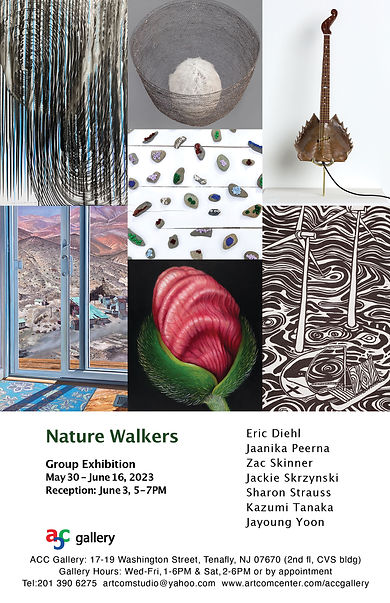

Eric Diehl's paintings of automobiles in US American landscapes mimic the form of cinematic imagery, commenting on contemporary life.
"Company Town" by Eric Diehl

Sharon Strauss works with collections and communities of things to capture a moment in time, exploring the intersection of place and identity.
"A Barnacles life" by Sharon Strauss

Kazumi Tanaka's sculptures are made of earthy materials and natural ink drawings which offer a meditative reflection on the beauty and fragility of life.
"Bloodless" by Kazumi Tanaka

Jackie Skrzynski collapses the perception of interior and exterior space by suggesting similarities between botany and anatomy, providing a sense of connection with a larger natural system.
"Poppy Bloom" by Jackie Skrzynski

Jaanika Peerna's work captures natural processes through drawings, installations, and participatory performances that incorporate line and water, while prompting audiences to reflect on the loss of natural ice through her Glacier Elegies project.
"Screech of Ice series" by Jaanika Peerna

Zac Skinner draws attention to the damage that humans have inflicted on the environment, and to the need to adapt to the evolving ecosphere.
"Otter" by Zac Skinner

Jayoung Yoon draws inspiration from Buddhist philosophy, collecting natural materials around the Hudson Valley and meticulously weaving them together with her own hair to convey the fleeting and ephemeral nature of our existence.
"The Offering Bowl" by Jayoung Yoon

Acc gallery presents an invitational exhibition under the title Exhibition
Title: Dissonance and Harmony "Collage, Art as an Object"
Doris Neidl, Saul Robbins, Jae Hi Ahn, J ulie Sim Edwards
Jihoe Koo, Injoo Whang, Eunyi Lee, Yunmin Lee
Curated by Jihoe Koo
May 09 ~ May 25, 2023
17-19 Washington St. 2nd fl (CVS Building), Tenafly NJ 07670 Tel 201 390 6275
< Dissonance and Harmony, Collage>
It's really amazing to think about the human being. Life brings about each person's memories and experiences created in that time and space become stories and history.
While preparing for this exhibition as a curator, I imagined this world as a large canvas.
And I thought it would be an opportunity to explore the formative world of artists who live in dynamism and diversity, conflict and dissonance, difference, tension and harmony within the canvas, and tell stories about their lives and works.
As the title suggests, this exhibition 'Dissonance and Harmony' presents a series of works of tearing, cutting, attaching, pasting, encountering disparate materials, overlapping images, and achieving formative harmony. I thought that the process of collage is similarly connected to the flow of our lives.
I hope that this special exhibition 'Dissonance and Harmony' will be a meaningful exhibition that tells various stories through interesting collage work and empathizes with and ponders how our lives can be harmonized even in dissonance.
<불협화음에서 조화로의 꼴라쥐>
합리적인 화면 구성과 과학적인 접근을 통해 캔버스 위에서 완벽한 조화를 추구했던 신고전미술은 18 세기 후반부터 19 세기 낭만주의 시대를 거치게 됩니다. 저는 이번 콜라쥐 기획전시를 준비하면서 이 시대에 관심을 갖게 되었습니다.
역사는 기존의 고정관념에서 벗어나 인간의 창의성과 유연한 사고의 모든 흐름을 통해 변화한다고 믿습니다. 희망의 빛으로 찾아온 낭만주의의 그림은 신고전주의 작품처럼 완벽하게 들어 맞지는 않지만 사람들을 위로하고 영혼의 조화를 찾는 작품으로 사람들에게 다가왔습니다.
인간의 삶에 대해 생각한다는 것은 정말 놀라운 일입니다. 한 사람 한 사람의 삶의 모습을 통해 생명이 창조되고, 그 시간과 공간 속에서 그들만이 만들어내는 기억과 경험이 모여 하나의이야기가되고 역사가됩니다. 큐레이터인 저는 이번 전시를 준비하면서 이 세상을 커다란 캔버스로 상상해 보았습니다.
그리고 그 캔버스 안에서 발생하는 역동성과 다양성, 충돌과 불협화음, 그리고 긴장과 차이 들로부터 조화롭게 만들어가는 작가들의 조형세계를 탐구하고 그들 만의 삶과 작업이야기를 들려주는 계기로 생각하였습니다.
이번 전시 제목인 ‘불협화음에서 조화로’ 설명하여 주듯이, 저는 이미지를 찢고, 자르고, 붙이고, 더하는 일련의 작업과정, 이질적인 재료와의 만남과 그 안에서 만들어지는 조형적인 조화, 그리고 이미지를 중첩하는 콜라쥐 작업 방식이 우리 삶의 흐름과 비슷하다고 생각했습니다 .
이번 기획 전시인 ‘불협화음에서 조화로의 콜라쥐’는 흥미로운 콜라쥐 작품으로 다양한 이야기를 전하며, 우리의 불협화음 같은 삶 속에서도 어떤 방식으로 조화를 이루며 각자의 삶을 만들어갈 수 있는지 생각해보고 공감을 나누는 의미있는 전시가 될 것을 희망해봅니다.

Doris Neidl, "In the beginning there was the breath of nature"
9 collages, each 4.7 x 6.1 inches, 2023
“In the beginning there was to breath of nature” (2023) is a poem written by my college
and friend John Sims. The small collages are part of a bigger work that could be interpreted
as a chessboard (he loved to play chess) or like an alphabet, which in turn is intended to
express his and my love of words.
"My work is often inspired by books and poems. For me, the artistic examination of a text, is
an attempt to create an analogy to a literary work, as a correspondence to its philosophical
problematic, its poetics, its structure and its truthfulness to life. However, the image should
also be able to exist without the the text.
I often work on series, which usually extend over longer periods of time, often years. I revise
them, I come back to them. The repetiton of a theme gives me the chance of artistic growth,
of graphic "surpassing oneself." I work on woodcuts, etchings or collages at the same time. I
am rarely "done" with something. Is there ever that point where you can say you've reached
your goal? For me doing art means to let go expectations and ideas, get involved with new
ideas and at the same time reinvent old ideas. The Austrian Autor Ernst Jandel once wrote:
"What I want are poems that don't leave you indifferent." What I want are Works of Art that
don't leave you indifferent."

Saul Robbins
Saul Robbins, New York City (White Light Meditation 241),2012Scratched Drawing onChromogenic Fuji Print,13x19
"Where’s My Happy Ending?
A friend once said that everyone has their own tragedy... this is mine.
Where's My Happy Ending? intends to be as subjective as it is provocative, navigating
and interpreting the world of medically assisted fertility treatments and the range of
anticipation, promises, and disappointments as experienced by prospective parents.
After too many tests and procedures, and more emotional upheaval than we care to
recount, this collection of photographs, drawings, and ephemera is the closest I have
come to making sense and taking control of this extremely challenging and personal
struggle.
After many years of trying, my wife became pregnant and gave birth to our very healthy
son, Theodore. While this series loosely chronicles the struggles and desires we held so
closely and privately, what began as a series of playful snapshots and naïvely obsessive
drawings has become a uniquely meaningful and enduring creative process.
Saul Robbins is interested in the ways people interact within their surroundings and the
psychological dynamics of intimacy. His photographs are motivated by observations of
human behavior and personal experience, especially those related to loss, unity, failure,
and the latent potential residing in traditional photographic materials and personal
history. Robbins is best known for “Initial Intake”, which examines the empty chairs of
Manhattan-based psychotherapy professionals from their clients’ perspective, and
“How Can I Help? – An Artful Dialogue”, a pop-up office into which he invites strangers
to speak with him about anything they wish for free, and in complete confidence."
Robbins’ work has been exhibited and published internationally. He received his MFA from
Hunter College of the City University of New York, where he studied under Roy DeCarava. He
is Adjunct Professor of Photography at International Center of Photography, NYFA, and SVA
and consults privately about communication strategies and professional development for
artists. His work can be viewed at: www.saulrobbins.com and @Saul.Robbins.

Jae Hi Ahn
Ahn_JaeHi_Connected _1
"Connected", the installation project, is based in part of collections from
Metropolitan Museum of Arts and New York Botanical Garden. This project is focused
on dynamic intercultural heritages and communities in NYC. By collecting, studying,
and painting images of traditional Korean earrings from MET and orchids from
NYBG, I created these watercolor works as the part of the large installation including
multicultural heritage pieces and orchids. Through "Connected", I hope all the races
of human unite and this project will help people on easing hatred to other races
and appreciate dynamic cultural surroundings.
"My work is focused on community well-being and human relationships to nature,
racism and sexism. Through creating multidisciplinary arts in the field of installation,
sculpture, ceramic, and watercolor painting, I try to connect human and nature, and
different cultures and different races together across the community in NYC."
Jae Hi Ahn’s work has been presented widely in New York at venues that include
Sunroom Project Space, wave Hill, Bronx; Chashama, NYC; Steinhardt Conservatory
Gallery at Brooklyn Botanic Garden; Broadway Windows at New York University; The
Field Sculpture Park at Art Omi, Ghent; Elizabeth Foundation for the Arts, NYC;
LMCC’s Arts Center at Governors Island; and Nathan Cummings Foundation, NYC.
She has been awarded grants from the Puffin Foundation, Brooklyn Arts Council
Community Arts Regrant (NYCDCA), Urban Artist Initiative Fellowship, and has
participated in residencies at Stone Quarry Hill Art Park, Cazenovia, NY; Ragdale
Foundation Residency, Lake Forest, IL; LMCC Swing Space, New York, NY; and Sculpture Space Residency, Utica, NY.

Julie Sim Edwards
"My collages are intimate in size and are meant to be experienced close up. They may be narrative or suggestive. I relish the spontaneous process of instinctive play without knowing whether it will result in wonderful visual chaos or composed lyrical poetry. Collaging is perfect for my creative process.
My recent work is a map of a personal journey, both literal and figurative. They are often compact in size and presentation, and I incorporate tearing, gluing, painting, stamping, scratching and mark-making to convey my experience, and perhaps to trigger memories or resonate with the viewer's own journeys."

Jihoe Koo
Title : Series of ‘My favorite things’.,Medium : Drawing with white pen, painting, collage on the hardboard gift box.
Size : 17”x 17” Year : 2023.
" I work in multiple media, from printmaking to illustration to installation art. I am interested in exploring time and memory with my print series _ "Childhood Memories" and Collage series _'My favorite things" about childhood and self-rediscovery. My pieces begin as a collage, then incorporates drawing and print through photography, linocuts, stencils, pencils, inks, markers, painting, white pen, and thread. It depicts all kind of the inner emotional state through the child's gestures, mood, memories, places and "my favorite things". The children in my works are colorfully dressed, but their faces have no color; they could be anyone, everyone, reminding viewers of their own childhood. I believe that my works will be a bridge sharing "empathy “with people. Children become a mirror."
Jihoe Koo was born in Seoul, Korea and moved to France for her study. She earned Diplome from École Nationale Supérieure des Beaux-Arts, section de la gravure in Paris, France and MFA in printmaking from Sung-shin Women’s University, Seoul, Korea. She had solo exhibitions and has participated in numerous national and international exhibitions including the 5th Sapporo International Print Biennale Exhibitions, Sapporo, Japan (2000), Mentoring Program for Immigrant Artists Project, NYFA, New York (2010), Dumbo Arts Festival in Brooklyn, New York (2011), the 6th Governors Island Art Fair, New York (2013), NYFA Curatorial exhibition ‘ Borderless: In Perspective’ curated by David Terry, Germany, Berlin (2017), ‘We The People’ curated by Heng-Gil Han and initiated by KAFNY, Ozaneaux ArtSpace, New York (2018), ‘Branch to Branch’ projects at New York Public Library (2017-2019) and Studio Anise showroom Art Series Exhibition Curating Project, New York (2019). Jihoe Koo is a New York based artist whose work spans multiple media from printmaking, sculpture, illustration and installation art.

Injoo Whang
"Boundless_0321",14 x 18 x 2 in, watercolor and sumi ink on paper, cut and collaged
"In my work, I explore the supposed binaries of the individual and the collective, of positive and negative spaces, of simplicity and complexity. I imagine their interconnectedness through drawings, paintings, collages and installations using sumi ink and water based paints on paper. My work starts from a single pattern, cut-out paper or mark making that I repetitively accumulate to create a larger whole. When tiny and seemingly insignificant individual pieces are gathered together, they generate a powerful collective body filled with visual illusions. Labor-intensive and meditative processes pay homage to invisible time and labor."

Eunyi Lee
"Salsa",2022, 14x 18in,mixed-media stitched fabric work on canvas
Eunyi Lee graduated from Ewha Womans University with a major in
Sculpture, Seoul,Korea
For the past 20 years, she has taught art to students of various
ages, from kids to adults, and students with visual impairment or
developmental disabilities.
Working predominantly with recycled fabric, Eunyi Lee has made
sewn dolls in the same shape but in various patterns and sizes and
often hangs hundreds of them from the ceiling to create one giant
installation piece. Her work also includes mixed-media stitched fabric work on canvas.

Yunmin Lee
Joy of Reincarnation, 8.5x12inch, 2023, Mixwd mwsia on paper
"My ego moves through the world of dreams and imagination in my paintings. I often don't worry about what to draw, instead allowing the work to be filled and created with ever-changing emotional curves. The process of painting is a desire for something beyond everyday life, filled with illogical and sensuous expressions.
I am drawn to the beauty of the unknown, and I believe that art can be a way to explore and express the mysteries of the human psyche. My paintings are often abstract, but they are always grounded in my own personal experiences and emotions."
She graduated from Sunhwa Arts High School, bachelor in Art Education at Hanyang University, and master in Fine Arts at Sejong University. Since 2008 she has continually worked on paintings, and had 5 private exhibits and participated in many group art exhibitions. Her recent art trend is to pursue various collage styles in paintings.

Stephanie Kim Solo Show
April 22 ~ May 06,2023
Reception April 22, 6~8pm

It has been a long time since I started drawing again, and for this exhibition, I want to express nature's captivating and surreal beauty through these new works.
Through the inspiring scenic views of nature, I have made the subjects of my works to be the different plants and elements of nature to express my feelings.
Nature is a surreal reality in itself, and the aspects of nature, such as trees, flowers, forests, and the sky, shape our essence and make up our lives. They are not only a part of us but something we share with the world. These elements of nature exude indescribable beauty, with different colors and forms that bring us happiness and joy.
The landscapes of nature enter my mind through my eyes, creating a vibrant and beautiful world that leads to new sensations and feelings. Every time I look at nature, I am transported to a new world of imagination, where I experience a world without pain or stress, a warm and tranquil world. The images and thoughts that arise in me when I look at nature remain in my mind as a part of my imagination.
Through my works, I want to invite you to immerse yourself in your own inner world while experiencing the beauty of nature.
Stephanie Kim is an artist who graduated from Seonhwa High School, Ewha Womans University's College of Fine Arts, and its graduate school. She has held several exhibitions and currently resides in Connecticut after immigrating to the United States. Her main medium is acrylic.

Press Release
April 03, 2023
Acc gallery presents an invitational solo exhibition under the title “ THE VIGOROUS LIFE SERIES, Between tranquility and comfort ”
Curated by Hobong Kim
April 03 ~ April, 20, 2023 (opening reception April,08 (Sat) 6:00pm ~ 8pm)
17-19 Washington St. 2nd fl (CVS Building), Tenafly NJ 07670 Tel 201 390 6275
“Between tranquility and comfort” "It's okay not to try so hard.”
This is a phrase from a YouTube sleep meditation that I listen to every night before going to bed. I really like this phrase because it makes me feel calm and at ease. It has helped me overcome insomnia that suddenly developed in my middle age.
The process and results shown in my recent work felt like a fierce battle. It was a combination of a strong will to escape from a dark environment and repeated actions taken at every moment. While working, the pain was long and the joy was short-lived. "Why am I repeating this painful work? Is it a healing process for me, or is it self-pity?" Whatever it was, my emotions and the subject matter merged, and I was swept away by waves of emotion until my emotions suddenly detached from the subject. Once the emotions detached, there was a state that emerged, which was either tranquility or comfort. In Korean, these two words have different first characters: "편(便)” and "평(平)." "편(便)" can mean comfortable, flattering, skilled, restful, and learning, but it can also refer to excrement or urine. "평(平)" can mean flat, govern, neat, comfortable, decide, complete, equipped, harmonious, and easy. Besides "comfortable," the usage of the two characters is quite different. "안(安)" means peace, comfort, and pleasure. This character is combined with others to express psychological states of mind. In the dictionary, "평안(平安)" means a peaceful state, and "편안(便安)" means a comfortable and stable state.
Poet Kim So-yeon wrote in her book "The Dictionary of the Mind" about the subtle differences between the two words. "We like comfort. A comfortable person, a comfortable space, comfortable time... being
comfortable means being convenient and safe. Everything is at our fingertips, and everything is like the tongue in the mouth. Therefore, we are relaxed without any desire. Being tranquil means peaceful and stable. Peace and stability are like the core of a typhoon, but to enjoy it, we need enough tension. Knowing this, our body, which already has tension, enjoys a peaceful state. To be tranquil means to be peaceful and stable. Peace and stability, like the eye of a typhoon, are at rest, but to enjoy them, one needs a certain level of tension. Because we already know this, our bodies know how to maintain a moderate level of tension while remaining in a state of peace, leaving us with a bit of enthusiasm. This peacefulness, maintained by a bit of enthusiasm and a moderate level of tension, requires invisible effort to carry out our relationships, places, and time properly. However, relaxed comfort without any desire does not take care of our relationships, space, or time that we belong to. When a family travels to a quiet countryside, everyone feels peaceful, but when someone else's discomfort is incurred at home, it often affects my comfort. My comfort may come at the expense of someone else's discomfort, but my peace can be a shared value with others.
Am I in a state of comfort or tranquility now, or somewhere in between? I want to enjoy the space between the tranquility and comfort that has come to me now, like the sunshine on a spring day after enduring winter.
Taesook Jeong is interested in the harmony between humans and nature. After majoring in oriental painting, she wants to express the flow that penetrates the vitality of humans and nature based on free and lively calligraphy stroke and traditional coloring. Because the experiences of people living in this era overlap with nature, they are very interested in the environment. She also projects the inspiration of nature, which she felt more deeply through travel, into her work. After she received her degrees from Hongik University and graduate school, she taught at the university and worked as a curator in a gallery, leading a number of environmental art projects. After she moved to the United States, she pursued a home, business, and study at the same time. She continued her work at New York University where she completed her art appraisal, and occasionally worked as an instructor on ASIAN ART at the Philadelphia Museum. She currently has large collections of her work at Temple university and Park Townes Place in Philadelphia. Writer Jeong Tae-sook lives with his family and dog Olly in Cherry Hill, New Jersey, looking for little gratification.
“THE VIGOROUS LIFE SERIES
평안함과 편안함 사이”
“그렇게 애쓰지 않으셔도 됩니다.”
매일 저녁 취침 전 틀어 놓는 YouTube 수면 명상에서 나오는 말이다. 나는 이 말이 참 좋다. 마음이 편안해지고 안심이 된다. 중년에 느닷없이 생긴 불면증을 극복하는데 도움이 된다.
지난 내 작업에서 보여지는 과정과 결과물은 치열한 나의 싸움 같았다. 어두운 환경과 벗어나려는 의지, 매 순간을 반복하며 쌓아가는 행동의 결합체이다. 작업을 하면서 고통은 길고 환희는 짧았다. ‘도대체 내가 왜 이런 고통스러운 작업을 되풀이 하고 있는 걸까, 나에 대한 치유의 과정인가, 혹은 자기 연민인가?’ 그 무엇이 되었던 간에 그 대상과 내가 합일되어 감정의 파도에 수없이 휩쓸려 다니다가 어느 순간 그 대상으로부터 나의 감정이 분리 되었다. 감정이 분리가 되니 생긴 상태가 있다. 편안함 혹은 평안함 이다. 한국어에서 두 단어는 앞의 글자 편(便)과 평(平), 두 글자가 다르다. 편(便)은 편할 편과 똥오줌 변으로 쓰인다. 편하다 이외에에 아첨하다, 잘하다, 쉬다, 익히다 등등의 뜻이 있다. 게다가 똥오줌 변으로 쓰인다니, 중국에서 발음때문에 공유하는 건지 아님 배변기능이 편해야 마음도 편한건지 알 수 없다. 그런데 후자는 확실히 연관성이 있다고 생각한다. 평(平)은 평평할 평, 다스릴 편으로도 읽힌다. 평평하다, 고르다, 가지런하다, 편안하다, 정하다, 이루다, 갖춰지다, 사사로움이 없다, 화목하다, 쉽다의 뜻이 있다. 편안하다의 공통점 외에 나머지는 사용처가 확연히 다르다. 안(安)은 편안 안으로 읽히고 즐거움, 편안, 좋아하다라는 뜻이 있다. 이 글자가 조합하여 마음의 심리 상태를 표현한다. 사전적으로 평안은 평화로운 상태, 편안은 불편하지 않고 안정된 상태를 의미한다. )平平平안안
시인 김소연은 ‘마음사전’에서 두 단어의 미묘한 차이점에 대해 이렇게 썼다.
‘우리는 편안함을 좋아한다. 편안한 사람, 편안한 공간, 편안한 시간…… 편안하다는 것은 편리하고 안전하다는 뜻이다. 모든 것이 손끝에 있고 모든 것이 입안의 혀와 같다. 그리하여 어떤 욕구도 없이 이완되어 있다. 평안하다는 것은 평화롭고 안정적이라는 뜻이다. 평화도 안정도 태풍의 핵처럼 정지되어 있으나, 그것을 누리기 위해서는 그만한 긴장감이 필요하다. 그것을 이미 알고 있기에 우리 몸은, 평안한 상태에서 조금의 의욕을 남겨놓고 적당한 긴장감을 유지할 줄 안다. 조금의 의욕과 적당한 긴장감을 유지한 평안함은, 스스로가 속해 있는 관계와 장소, 시간 따위를 잘 영위하기 위해 보이지 않는 노력을 기울인다. 하지만 어떤 욕구도 없이 이완된 편안함은 스스로가 속해 있는 관계와 공간과 시간 등을 돌보지 않는다. 조용한 시골로 가족이 여행을 떠났을 때에 모두가 평안을 느끼는 반면, 집에서 느끼던 나의 편안함에 누군가의 수발이 전제될 때가 많은 것처럼. 나의 편안함은 누군가의 불편함을 대가로 치르지만, 나의 평안함은 누군가와 함께 누리는 공동의 가치가 될 수 있다.
나의 상태가 지금 편안함인가, 아님 평안함인가, 아님 그 중간에 어디쯤인가? 지금 나에게 찾아 온 평안함과 편안함의 사이를 누리고 싶다. 마치 겨울을 지난 봄날의 햇살처럼.
정태숙 작가는 인간과 자연의 조화에 관심을 갖고 작업한다. 동양화를 전공한 그는 자유롭고 기운생동한 필법과 전통적 채색을 바탕으로 인간과 자연의 생명력을 관통하는 흐름을 표현하고자 한다. 이 시대를 살아가는 사람들의 경험이 자연에 중첩되어 살아가기에 환경에 대해서 많은 관심을 갖는다. 또한 여행을 통해 더 깊이 느낀 자연의 영감을 작업에 투영한다. 홍익대학교와대학원에서 학위를 취득 후, 대학에서 강의를 했으며 화랑에서 큐레이터로 일하며 다수의 환경미술 기획을 주도하였다. 미국으로 이주한 후 가정과 사업, 그리고 공부를 병행하였다. 뉴욕대에서art appraisal 을 마치고 작업을 계속하며 간간이 필라 뮤지엄에서 ASIAN ART에 대한 강사로 활동하기도 했다. 현재 Philadelphia 에 있는 Temple university 와 Park Townes Place 에 대형 작품이 소장되어 있다. 정태숙 작가는 가족과 강아지 올리랑 더불어 뉴져지 체리힐에서 사소한 만족을 찾으며 살고있다.
Feb, 14~ March, 09, 2023
Special invitational exhibition
under the title “ out of boundless”
Kim Kang Yong, Sung Ho Choi, D. Dominick Lombardi are three artists I have selected who have been working tirelessly since 1970’ to establish themselves as a modern artists using various mixed media. They are highly active in Korea, as well as USA and Europe and constantly strive to create and seek out new ways of artistic expression.
Kim Kang Yong
Sung-ho Choi
D. Dominick Lombardi


Reality + image 2201 - 2081, Mixed media,2022 20x26
Kim Kang-Yong graduated Hong Ik Univ. and Hong Ik Graduate school, formal professor of Hong Ik Graduate school. He is a Korean Asian Modern & Contemporary painter who was born in 1950, conveyed the realities of life in Korea on canvas in a hyperrealist manner in the 1970s. His longtime subject matter, bricks, has now become the artist’s trademark. KIM’s bricks, presented in a neutral and mechanical representation of real bricks, can be considered as Korean reinterpretation of Hyperrealism. KIM’s paintings are so distinctive that they paintings are clearly distinguished from traditional figurative art as well as American Hyperrealism, which the artist was influenced by. Thus, what characterizes his work is not hyperrealist technique – it is simulacre, whereby an image becomes independent from the original, turns far more real than the original itself and functions as its own reality eventually.KIM’s hyper-realistic work, an unprecedented innovation, renders far beyond ‘representation.’ They pose fundamental questions about an ‘image’ and a ‘painting’ hence the artist encourages the viewers to contemplate. Ultimately, the artist delivers a far-reaching question: where is the truth and justice in this era in which history, reality and even the future have been rendered as simulacre? This is why we are so drawn to KIM Kang Yong’s bricks, which may seem like a harsh cold-hearted truth at first glance, as they reclaim sympathy and compassion.
His works are owned by art museums, public institutions, and the National Museum of Modern and Contemporary Art, and can be seen at famous auction houses such as Christie's and Sotheby's.
김강용 작가는 홍익대학교와 동대학원을 졸업 홍익미술대학원 교수 역임, 1970년대부터 현재에 이르기까지 줄기차게 벽돌을 그려왔고, 이제 벽돌은 그의 트레이드마크가 되었다. 실재 벽돌의 중립적이고 기계적인 재현처럼 제시된 김강용의 ‘벽돌회화’는 사실 실재의 벽돌을 모사한 것이라기 보다는 작가 자신의 생각 속에 있는 벽돌을 그린 것이라 할 수 있다. 다시 말해서, 실재 모래를 화면 위에 고루 펴 바른 후, 그 위에 벽돌을 그림으로써 김강용의 벽돌은 실재 벽돌의 ‘리얼리티’를 품고 있지만 벽돌의 재현이나 그림자로서의 이미지가 아닌 추상적 존재로 탈바꿈한다.
김강용의 벽돌 회화는 그 무한 반복과 단순함 속에 수많은 변화를 내포하고, 창조적 파격들을 숨긴 듯 드러내며 관객으로 하여금 사색하도록 권한다. 그리고 궁극적으로 역사와 현실, 그리고 미래마저 시뮬라크르화 한 이 시대에 진실과 정의는 어디에 있는가? 라는 심각한 질문을 던진다. 진실과 허구의 구별이 모호하고, 원본의 의미가 무색한 오늘날 김강용의 차갑고 딱딱한 진실과도 같은 벽돌 회화가 그리워지는 이유가 여기에 있는 것이다. 그렇기에 공허해 보이는 그의 회화 한편에는 왠지 슬픈 듯, 따스한 듯 인간적 연민의 미소가 어려 있다. 그의 작품들은 미술관 공공기관 국립현대미술관등에서 소장하고있으며 유명옥션 크리스티 소더비등에서 작품들을 볼 수있다.

CCWS 110, 2021 Acrylic and ink on paper and oil on Wood panel 14x 42"
CCWS 108, 2021 Acrylic and ink on paper on Wood panel 16 3/8" x 16 1/2"
CCWS 106, 2020 Acrylic and ink on paper on Wood panel 16 1/2" x 17"


CCWS 59, 2020 Acrylic and ink on paper on Plexiglas 12 3/8" x 11 1/2"
The Cross Contamination Series
Artist, writer and curator D. Dominick Lombardi is a painter, sculptor and mixed media artist working primarily in the realm of Pop Surrealism. He has written for numerous publications including The New York Times, ARTnews, The Brooklyn Rail, Juxtapoz, New Art Examiner and Art & Antiques. As a curator, he has presented a variety of exhibitions focusing on the environment, social behavior, identity, food, icons, humor etc. in institutions such as the Morean Art Center in St. Petersburg, FL, the Hampden Gallery at Amherst, MA, the Lesley Heller Workspace in New York, NY, and The Housatonic Museum in Bridgeport, CT. As a visual artist, he has shown extensively in the U.S., in Asia and Europe in solo and group shows. A prolific visual artist, Lombardi’s 45-year retrospective just completed its 3-state tour, traveling from Murray, KY, to Colorado Springs, CO, then to Cortland, NY. The Cross Contamination Series in this exhibition utilizes an abstract field of color overlaid with numerous unique drawings (what he calls ‘stickers’) that are affixed to the surface. The cross contamination of media and purpose offers a dialogue between old and new, progress and tradition, and practice of form versus comic illustration.
아티스트, 작가 및 큐레이터 D. Dominick Lombardi는 주로 팝 초현실주의 영역에서 작업하는 화가, 조각가 및 혼합 미디어 아티스트다. 그는 The New York Times, ARTnews, The Brooklyn Rail, Juxtapoz, New Art Examiner, Art & Antiques 등 수많은 출판물에 글을 기고했다. 큐레이터로서 그는 플로리다주 상트페테르부르크의 모린 아트 센터, 매사추세츠주 애머스트의 햄든 갤러리와 같은 기관에서 환경, 사회적 행동, 정체성, 음식, 아이콘, 유머 등에 초점을 맞춘 다양한 전시를 선보였다. , 뉴욕주 뉴욕의 Lesley Heller 작업 공간, 코네티컷 브리지포트의 Housatonic 박물관. 시각 예술가로서 그는 미국, 아시아, 유럽에서 개인전과 단체전을 광범위하게 선보였다. 다작의 시각 예술가인 Lombardi의 45년 회고전은 켄터키주 머레이에서 콜로라도주 콜로라도 스프링스, 뉴욕주 코틀랜드로 여행하는 3개 주 투어를 막 마쳤다. 이번 전시의 Cross Contamination 시리즈는 표면에 부착된 수많은 독특한 드로잉(그가 '스티커'라고 부르는 것)이 겹쳐진 추상적인 색상 필드를 활용한다. 매체와 목적의 혼합의 교차는 옛것과 새것, 진보와 전통, 형태 연습대 코믹 일러스트레이션 사이의 대화를 제공한다.


Everlasting, 2022 seal ink, lottery ticket on wood 44.5” x 48”
Mist, 2022 seal ink, lottery ticket on paper 25” x 35”

Drawing for Pulse, 2022 seal ink, lottery ticket on paper 18.5” x 42”
Most people making marks on lottery tickets hoping to win monetary fortune. I, instead, depict desire, imagination and state of my mind metaphorically on the ticket. Those often form an ironic counterpoint to the everyday meaning of lottery ticket. As if ordinary people choose numbers for a billionth chance, and as if Asian ink painters focus on achieving superb brush strokes with spirit, I am seeking cosmic energy by printing thousands of dots on the field of lottery tickets.
대부분의 사람들은 물질적 행운을 기대하면서 복권에 점을 찍는다. 나는 그와달리 복권위에 마음속에 담긴 염원, 상상 그리고 정신적 상태등을 은유적으로 시각화한다. 그러한 의도는 주로 복권이 가지는 보편적의미에 풍자적이고 대조적으로 드러난다.
보통 사람들이 수천만분의 일 정도 확률을 기대하면서 숫자를 선택하듯이 그리고 동양화가들이 기운생동하는 붓질을 추구하며 온정성을 쏟듯이 나는 이 세속적 행운의 상징물인 복권들위에 수많은 점들을 찍으면서 신비한 우주적 기운을 찾고 싶다.
Born in Seoul, Korea, Sung Ho Choi has lived and worked in New York City and Bergen County of New Jersey since 1980. He completed BFA at Hong Ik University in 1980 and received MFA from Pratt Institute, New York in 1984. Nearly 45 years, His works have been shown at the many exhibitions in the Northern and Central America and Asia. As a bi-cultural artist, Choi has depicted the experience of being the “other,” of contrasts and complexities of minority existing within a majority. Beyond his creative endeavor, he has restlessly worked as a cultural activist, an art educator and data collector in New York City and the various communities of Bergen County since 1988. He co-founded Seoro Korean Cultural Network in 1990 and organized many cultural events including the traveling exhibition, Across the Pacific: Contemporary Korean and Korean American Art at Queens Museum of Art in 1993.
서울에서 태어난 최성호는 1980년부터 뉴욕시와 뉴저지 버겐카운티에서 거주하며 작업하고 있다. 그는 1980년 홍익대학교에서 학부를 졸업하고 1984년 뉴욕 프랫 인스티튜트에서 석사학위를 받았다. 그의 작업은 지난 45년간 북미, 중미 지역과 아시아의 여러 기관에서 소개되었다. 최성호는 두문화를 오가는(bi- cultural)작가로 다수안에 존재하는 소수자의 복잡성과 대조적 측면을 즉 타자가 되는 경험을 묘사 해왔다. 창작자로서의 노력외에, 최성호는 1988년부터 뉴욕시와 버겐카운티의 다양한 공동체안에서 예술교육가이자 데이터 수집가로서 쉬지않고 활동을 해왔다. 1990년에 서로문화연구회를 공동 설립하고 1993년 퀸즈미술관에서 개최된 순회전 <태평양을 건너서: 동시대 한국미술과 한국계 미국미술>을 포함하여 다양한 문화 이벤트를 기획, 조직하였다.
ACC Gallery presents
"INVISIBLE ROOM", Group show
Jan 17 ~ Feb 11,2023
opening reception 6 to 8 pm, Jan 21 (Sat)
This show examines our interpretations of daily life as it fulfills or rejects social norms.
How do our connections create a sense of play and intimacy? How is connections also a limiting experience? The artists represented here are concerned with the process of gaining perspective on these experience.
Curated by Sunhee Yoon
본 전시는 사회적 규범들을 충족하거나 거부하는 일상에 대한 우리의 해석들을 점검해본다.
여성으로서 사회와의 관계 속에서 어떠한 친밀감을 경험하고 형성하는가 혹은 환경속에서 어떠한 제한적 경험을 하는가?
전시에 소개된 작가들은 이러한 경험들을 토대로 얻은 관점을 제시한다."

7 artists
1, JeongMee Yoon
Born in Seoul, South Korea in 1969, she majored in painting at Seoul National University, Seoul, photography design at Hongik University, Seoul, and studied at the School of Visual Arts, New York, USA.
Red Face series, Light jet Print
“My work is about (Korean) working woman who have to juggle many roles simultaneously. I write and wipe out ‘KOREAN’, ‘WOMAN’, ‘MOTHER’, ‘WIFE”, ‘DAUGHTER-IN-LOW’, ‘ENDURE’, ‘SURVIVE’, AND ‘DAUGHTER’ words repeatedly on my face with pure red lipstick. Also, I do banal house matters hardly wearing superman costume in another video work. The piece seems deviant, stupid and serious all at the same time as well as ironic, so viewers fell funny, uncomfortable and smirk with bitter smile. The imagery is a little disconcerting.
2, Jihye Baek
Jihye Baek is an artist and photographer born in 1986 in Seoul; She received a Bachelor’s Degree from Kingston University in England and a Master’s Degree from Pratt Institute in New York, U.S.A. Currently residing in New Jersey, she works on photography and mixed-media on the basis of female psychology and sociology.
“My current work in photography and mixed media deals with the abstract experience of motherhood and domestic life. Images of domestic space and surreal still life images reflect on the happiness of life which create a tension between happiness and sense of emptiness; implicitly and explicitly, suggesting psychological disquiet. Metaphorically, my works are a reference to memories based on unexpected emotions.”


3.Minjung Lee
“My work employs realistically drawn surfaces of various objects as a sculptural medium. Blurring the line between sculpture and drawing, the work is placed at the conflicting state of being present and represented, and material and immaterial to measure the distance between the physical world and mind.”
Mirror Gazing, 2020
32x25x2.5 inches(framed)
colored pencil on museum board, picture frame buttons, artist's frame.

4, Yukiko Nakashima
My studio practice is an analysis of my identity through unverbalized narratives. I have many stories and emotions untold, just like any woman in today’s world.
The brush strokes are the urgencies. The layering is the scar. The colors are the voices. The drippings are the bodily fluids. The paint blobs are the records of passing time and the open space is the breath taken. The abstraction is the language that I construct to speak my inner most feelings.
I believe it is artist’s duty to continue to speak up, in the manner that she feels is best suited, to say “we are here, and we will not be invisible.”

5, Eunsun Park
Eunsun Park currently lives and works in Seoul. Graduated from the Department of Western Painting at Dongguk University College of Art in Seoul and graduated from the National Academy of Rome, Italy.
Selected as a resident artist program at home and abroad, 'D' International Residency Program (Daemyung Studio), Gana Atelier, Changdong Art Studio 1st, Birla Academy of Art and Culture Residence (Calcutta, Shantiniketan, India), Passages ( Trois, France) and the Cite' Internationale Des Arts.
A Road, a.d.1/10, 80x54.3cm lenticular 2022

6, Julia Wagner
Julia Kadlec-Wagner is Director of the Metro Writing Studio located on the Metropolitan Campus of Fairleigh Dickinson University where she Lectures in Academic and Creative Writing. She earned her Certificate to Teach Writing at Montclair State University while helping to establish their First Year Writing Program.
“I have a powerful connection to language often seeing patterns and images in words beyond their written expression. This fascination was supported and developed through reading, writing, and music. Music, as a language beyond words, provides many narrative possibilities. I love taking words beyond their literal meanings. Playing with language, meaning and nonsense, as well as rhythm, is a rich source of inspiration in all my poetry. “

7, Sunhee Yoon
Born in Seoul, Korea, Sunhee Yoon received her MFA from Pratt Institute. She is an environmental installation artist, and art educator. She teaches at Fairleigh Dickinson University and Manhattanville College. She has had 12 solo shows, as well as group shows in the United States, Korea, and Germany.
“The Living Organisms” presented here, resemble parts of the human body, as well as mountains, clouds, and trees that she combines to symbolize the global environment. Much like the mother-child relationship, human beings also have existing relationships with nature expressed in sentiments such as “Mother Earth” and “Homeland”. Using aluminum wire, pipe-cleaners, felt, and yarn, Sunhee combines the physical and biological bonds humans create, and re-imagines them as emotional ties, and ties we create with the natural world.”
